It’s very common for new bloggers to encounter a situation where their blog ranks well for a few days or hours, and then suddenly disappears from Google search results.
If you are a new blogger and have recently started your new blog, you must have encountered this problem. If so, you will find the solution here today.
In this article, I will explain in detail why new blog posts suddenly disappear from Google search results after ranking, and I will also tell you how to fix it.
When I started my new blog, the articles I wrote within the next month started ranking well in Google, and I was also seeing impressions and clicks in Search Console.
I noticed that, my blog articles started ranking for some keywords (average CTR = 17.8%, average position = 1.3, approximately 50-60 impressions daily).
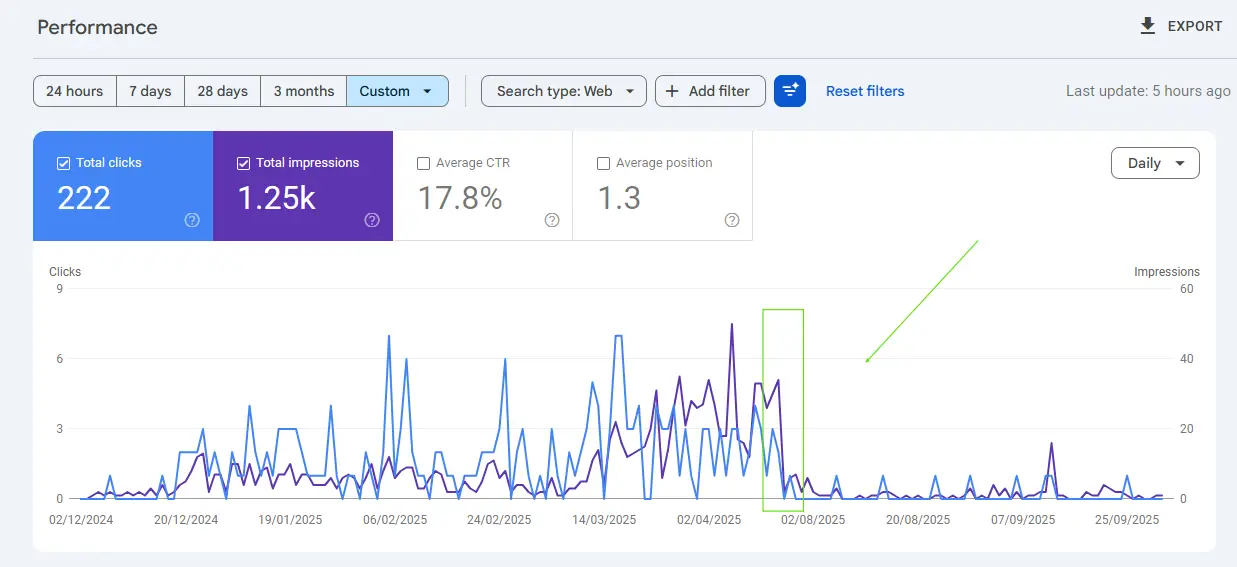
But then, after a few days, they suddenly stopped ranking altogether, and in less than a month, they had almost zero impressions in Google Search Console.
So I know how frustrating it is when your new blog posts suddenly disappear from the top rankings in Google search results after initially achieving them.
I have found the reason and the solution, and now my site’s articles are ranking in Google again. Let me tell you how I did it.
Quick Summary:
- Why Drop: Google “Honeymoon Period” ends, testing phase is over.
- Common Cause: Lack of initial trust signals & backlinks.
- The Fix: Update content, build internal links, and wait for re-indexing (2-4 weeks).
- Why New Blogs Rank then Disappear from Google Search?
- How to Fix a Blog Sudden Ranking Drop in 2026
- New Blog Ranking Drop Related FAQs
- Conclusion
Why New Blogs Rank then Disappear from Google Search?
A sudden drop in the ranking of a new blog is usually caused by algorithm updates, technical issues, or the “Google Dance” or “Google Sandbox” effect.
Why New Blogs Rank Drop Suddenly:
1. Google Initial Testing Period
When a new blog publishes content, Google often gives it temporary visibility to test how users respond. During this phase, the site may rank higher than expected for a short period.
Google observes signals such as clicks, time spent on the website pages, and overall user behavior to evaluate whether the content satisfies search intent.
If these signals are weak or the website lacks authority, rankings often drop once this testing phase ends. This phase is commonly called the honeymoon period.
This ranking fluctuation is known as the Google Dance or Google Sandbox, but regardless of the name, it helps to understand Google’s ranking adjustment process.
2. High Competition & Low Authority
Another common reason why new blog rankings drop suddenly is high competition. When a new blog ranks initially, Google temporarily tests the page against existing results.
However, once your new website testing phase ends, stronger and more established websites usually reclaim their positions.
High-competition keywords are typically dominated by:
- Older websites
- Strong domain authority
- Established topical authority
- Consistent backlinks and user trust
A new blog may briefly appear on the first page, but without enough domain authority, it becomes difficult to compete in the long term.
As a result, Google gradually pushes the new blog down in rankings and prioritizes pages that have proven reliability, depth, and consistency over time.
It is very important to tell you one thing here that this is not a penalty, it’s simply Google favoring trusted competitors for competitive search queries.
3. Lack of Backlinks & Trust Signals
Backlinks play a crucial role in determining how long a website page can maintain its ranking in Google search results.
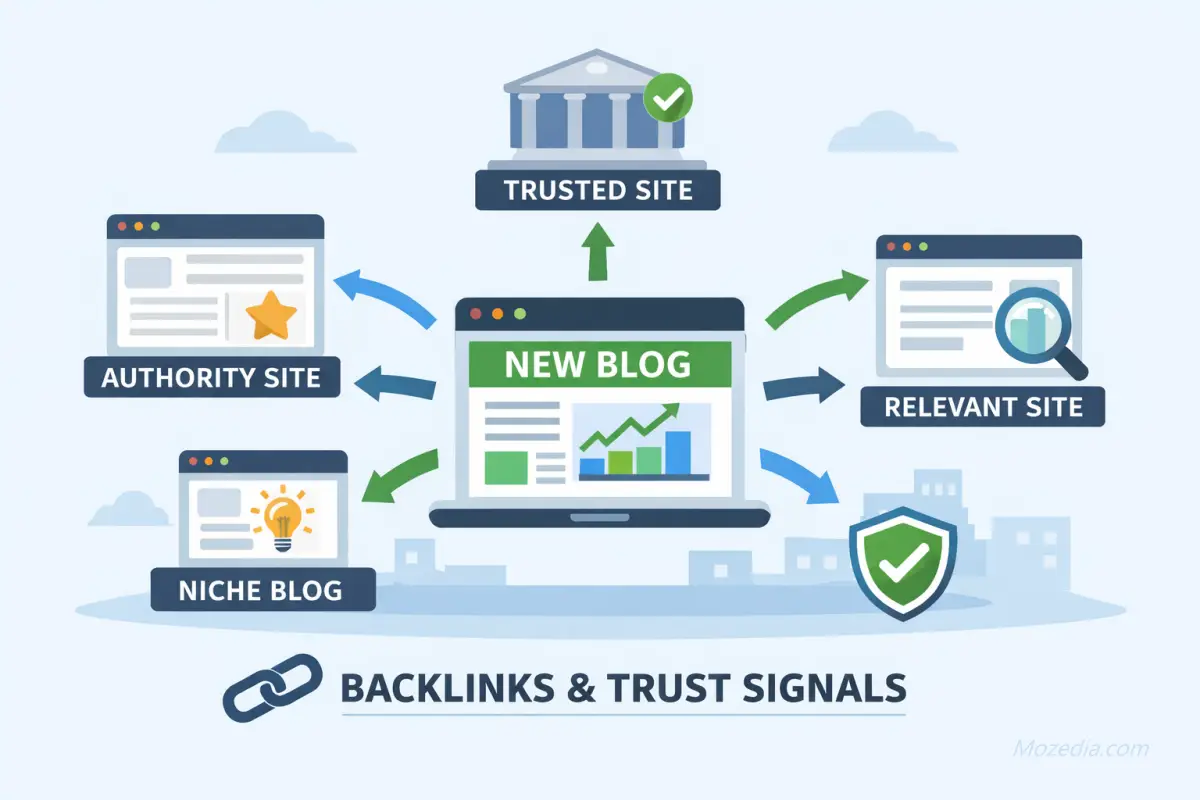
New blogs often rank for a short period even without strong backlinks because Google initially tests the relevance of the content.
However, once the testing phase ends, Google re-evaluates the page using quality backlinks, strong trust and authority signals.
This means, if your new blog has no quality backlinks, it will struggle to compete with older websites that already have an established backlink profile.
Most high-ranking pages are supported by these factors:
- Relevant and authoritative backlinks
- Natural link growth over time
- Strong trust signals from other websites
Without these signals, it’s difficult for Google to trust a new blog. Consequently, when more authoritative pages are prioritized, the ranking of a new blog often drops.
Although backlinks are not always essential for ranking on Google, you can still get your website to rank on Google without them. So, read this guide.
4. Content & Optimization Issues
The quality and optimization of your website’s content play a crucial role in how long your posts can maintain their rankings.
I have seen in many cases that new posts rank for a short period due to their freshness, but then fail to maintain their position.
1) Thin or Low-Quality Content
If the content doesn’t fully satisfy search intent or lacks depth, Google may initially test it, but will likely replace it with more comprehensive and authoritative pages later on.
2) Weak Keyword Targeting
Targeting broad, high-volume, or highly competitive keywords too early can lead to a rapid drop in rankings. New blogs often struggle to compete for these keywords without sufficient authority.
3) On-Page SEO Limitations
The absence or poor optimization of on-page elements such as meta descriptions, header structure, or keyword placement can negatively impact rankings after Google completes its initial evaluation.
If you optimize your site’s content effectively, your posts will not only appear in Google search results but will also rank in the People also ask box.
5. Technical Reasons
Technical issues can also cause the ranking of many new blogs to drop suddenly, even if your content is well-written.
1) Technical Errors
Incorrect robots.txt rules on your site, accidentally added noindex tags and indexing restrictions, or slow page load speed can all cause a ranking drop.
This is because these technical mistakes prevent Google and other search engines from properly crawling or evaluating a page.

Websites experiencing these issues may see their pages rank for a while, but they will disappear from search results once search engine bots detect these problems.
2) Orphaned Content
If a blog post has no internal links pointing to it, Google and other search engines may consider it less important or irrelevant.
Without internal signals supporting the page, its visibility decreases over time, and it may eventually be removed from search results altogether.
We have written a separate article about optimizing websites for SEO, so please read that for more information.
6. Algorithm Updates
Google regularly releases core and spam updates that change how content and websites are evaluated.
These updates affect rankings, meaning your site’s ranking can fluctuate even if you haven’t made any changes to it.
New blogs or websites with fewer trust signals are often more sensitive to these updates and are more significantly impacted by search engine algorithm updates.
When Google adjusts its ranking system, the visibility of new or less popular sites decreases, while the rankings of more established websites and blogs remain stable.
Means, your site’s ranking might suddenly drop due to a Google algorithm update, not because of a penalty, but simply because Google’s evaluation criteria have changed.
7. Keyword Stuffing or Spam Signals
Using aggressive SEO techniques in the early stages of a new blog can trigger spam-related signals in Google’s algorithms.
Excessive keyword repetition, unnatural language, or improper optimization techniques can prompt Google to re-evaluate the page.
In some cases, these signals can lead to lower rankings, or if the behavior is more severe, Google may even take manual action.
However, in most cases, Google simply reduces visibility as part of its spam detection and quality assessment processes.
Therefore, pages that rely on spammy optimization techniques quickly lose their initial visibility and rankings.
Now that you understand why new blog rankings drop suddenly, let’s look at what you can do to prevent this from happening and recover lost rankings.
How to Fix a Blog Sudden Ranking Drop in 2026
Once you understand why your new blog’s ranking has dropped in Google search results, the next crucial step is to fix the underlying issues without delay.
Most ranking drops can be recovered if you identify the problem quickly and address it correctly.
1. Audit Google Search Console
In my opinion, starting with Google Search Console would be a good idea. It’s the best and easiest way to get direct feedback from Google.
First of all, you need to review the Manual Actions section to avoid any penalties.
After that, check the Indexing section and verify that your pages are still indexed and haven’t been marked as excluded.
If a page suddenly shows “Noindex detected” or “Crawled – currently not indexed,” this alone could be the reason for a drop in rankings.
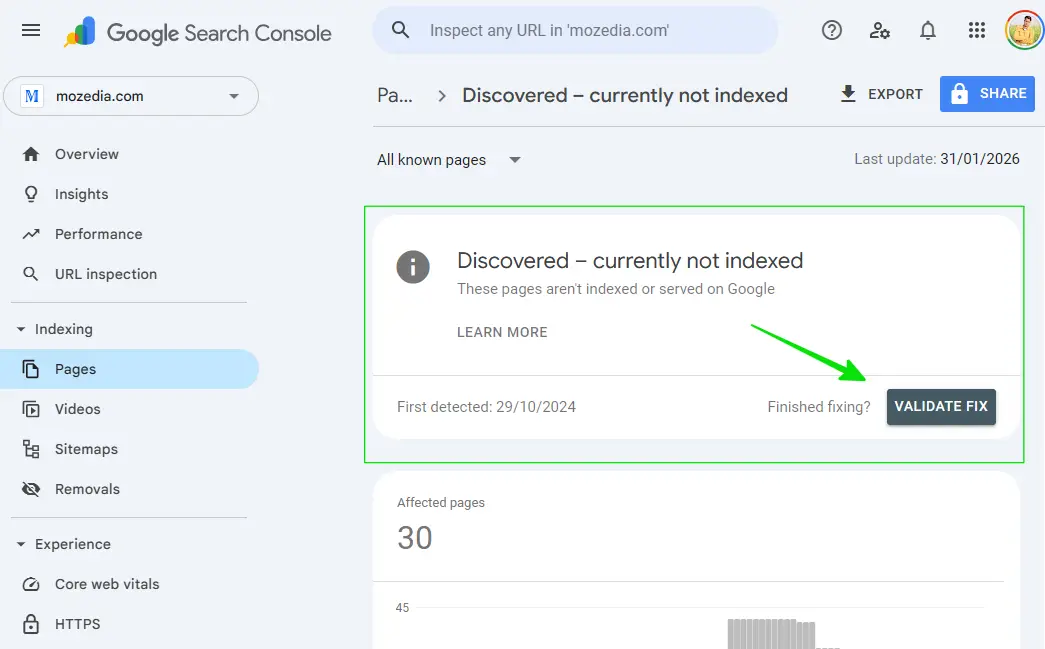
The simple solution is to upgrade the content of the pages that Google has excluded from indexing, and then click on VALIDATE FIX button to fix the issues.
2. Review Recent Changes
Look at what you changed before the ranking drop of your website. This includes theme updates, plugin changes, URL edits, or content rewrites.
In my experience, website ranking drops are often due to theme changes, structural changes, even if those changes seem minor.
For example, If you edited URLs or permalinks without proper redirects, Google stops trusting the old ranking signals.
Or, if you frequently change your blog’s theme, your site’s search ranking can also drop.
3. Improve Content Quality
Improve the clarity and quality of your content, add missing information, and ensure the content answers all the questions users are searching for.
If your post explains what something is but not how or why, Google will replace it with a page that covers the topic more comprehensively.
You don’t need to rewrite everything, just focus on strengthening the pages that already show potential and those that contain incomplete information.
And, If you don’t know which topic to work on, first find your niche with the help of this guide.
4. Fix Technical Issues
Technical issues don’t always immediately remove pages from Google search result, but they gradually push them out of search results.
Check website page loading speed, mobile usability, crawl accessibility, and internal errors to ensure Google can properly process your pages.
For example, a page that loads correctly on a desktop but breaks on mobile will lose ranking after Google’s mobile evaluation.
5. Analyze Backlinks
Backlinks influence how much Google trusts a page over time. If essential links are lost or low-quality links appear, rankings can drop, you can disavow bad links.
You don’t need a lot of backlinks, you just need some clean, relevant backlinks that give you real value, so build a few quality backlinks for your blog.
For example, if your page had several good backlinks and one of them was removed, Google might reduce its trust in that page.
6. Build Internal Links
Internal links are crucial for the SEO of every website page, helping Google understand which pages are important and how your content is interconnected.
You need to ensure your affected pages are linked to relevant posts, categories, or guides on your site; related links should be present on every page.
For example, a page without internal links often struggles to recover its ranking in Google, even if the content on that page is excellent.
7. Target Long-Tail Keywords
Many bloggers make the mistake of creating a website and immediately starting to write content similar to other large websites, targeting broad keywords.
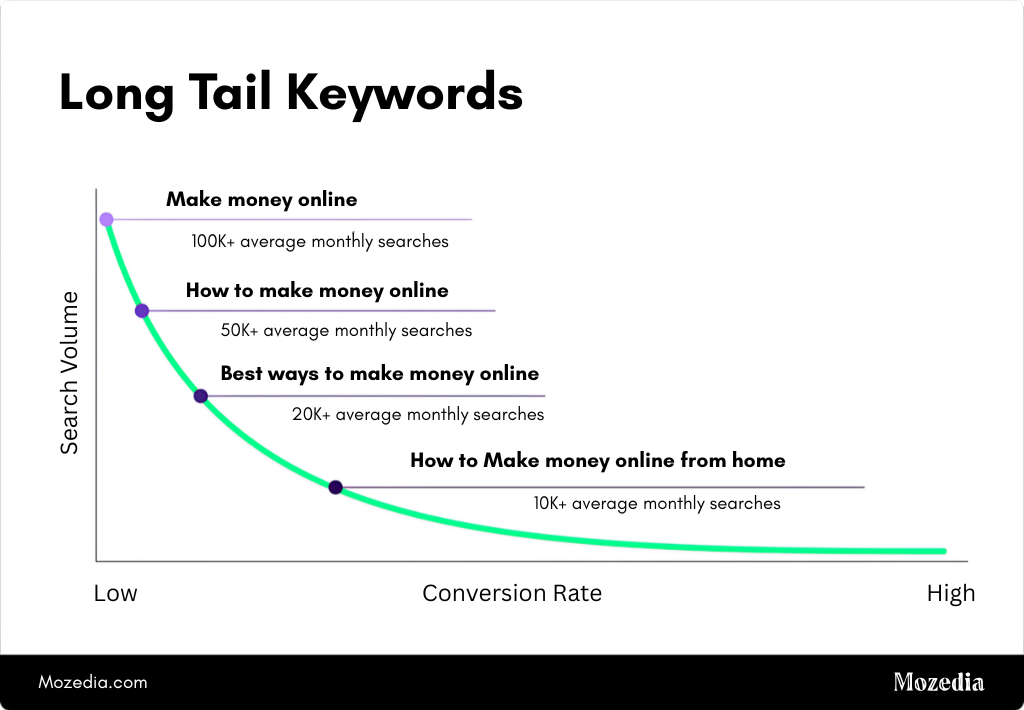
This often leads to their articles ranking well initially in Google, but then their rankings drop later. Therefore, you should focus on more specific questions.
Ranking for long-tail keywords is much easier and attracts more targeted traffic. You can also use our keyword research tool for this purpose.
For example, instead of trying to rank for “blog SEO” focus on “SEO tips for new bloggers with low traffic.”. I’m sure your article will rank well on Google.
8. Be Patient
Google needs time to recrawl and re-evaluate updated pages, so please avoid making frequent changes, as this may delay the recovery process instead of helping it.
After making improvements, you should avoid making continuous changes and give Google time to re-evaluate your content.
Remember that even after fixing your website’s content and technical issues, it may take several weeks or even months for your rankings to stabilize again.
If you follow these steps carefully, most ranking drops can be stabilized and recovered over time.
If you want complete information about blogging mistakes, please read our article:
New Blog Ranking Drop Related FAQs
Below are some of the most frequently asked questions related to the sudden drop in ranking of new blogs in Google Search.
These FAQs address common concerns and provide practical, easy-to-understand answers to help you.
Why Does a New Blog Rank Initially and Then Suddenly Disappear?
Google initially tests new Content. After this Testing Phase, if the Blog lacks strong Authority, Engagement, or Trust Signals, the Ranking drops.
Is a Sudden Drop in Ranking a Google Penalty?
No. In most cases, it’s not a Penalty. It’s usually due to Google’s Algorithm Adjustments, Competition, or the Google Sandbox Effect.
What is the Google Sandbox or Google Dance?
The Google Sandbox is a Phase where New Websites experience Fluctuations in their Rankings. During this Time, Google evaluates User Behavior and Content Relevance.
How Long Does It Take for a New Blog Ranking to Stabilize?
It typically takes a Few Weeks to a Few Months. This depends on the Quality of the Content, Keywords, Backlinks, and Site Trust.
Can Technical SEO Issues Cause a Drop in Rankings?
Yes. Noindex Tags, Crawling Errors, Slow Page Speed, Mobile Issues, and Orphaned Pages can all cause a Drop in Rankings.
Do Backlinks Matter for a New Blog?
Yes. While Ranking is possible without Backlinks, Quality Backlinks and Trust Signals are essential for maintaining Long-Term Rankings.
What is the Best Way to Recover from Drop Rankings?
Improve your Content, Fix Technical Issues, Strengthen Internal Linking, Target Long-Tail Keywords, and give Google Time to Re-Evaluate your Site.
Conclusion
A sudden drop in a new blog’s ranking can be disheartening, but in most cases, it’s a normal part of how Google evaluates new websites.
This doesn’t mean your blog has failed or that Google has penalized you; there’s no need to be discouraged. You just need to fix the problems.
Find out why and how this happened, understand it thoroughly, and make calm, informed decisions instead of making hasty changes.
If you focus on improving content quality, fixing technical issues, targeting the right keywords, and giving it time to be re-evaluated, the rankings will return.
Remember, successful blogging isn’t about quick wins; it’s about consistency, patience, and creating real value for your users.
Also read:
If you stay on the right track, Google will eventually reward your efforts. Just work diligently and be patient.