Now optimizing content only for search engines isn’t enough. To increase traffic to your website in 2026, you’ll need to focus on GEO for AI chatbots like ChatGPT.
Today in this article, I will show you step-by-step how to get traffic from AI chatbots like ChatGPT, Google Gemini, Claude, Perplexity, Copilot and DeepSeek.
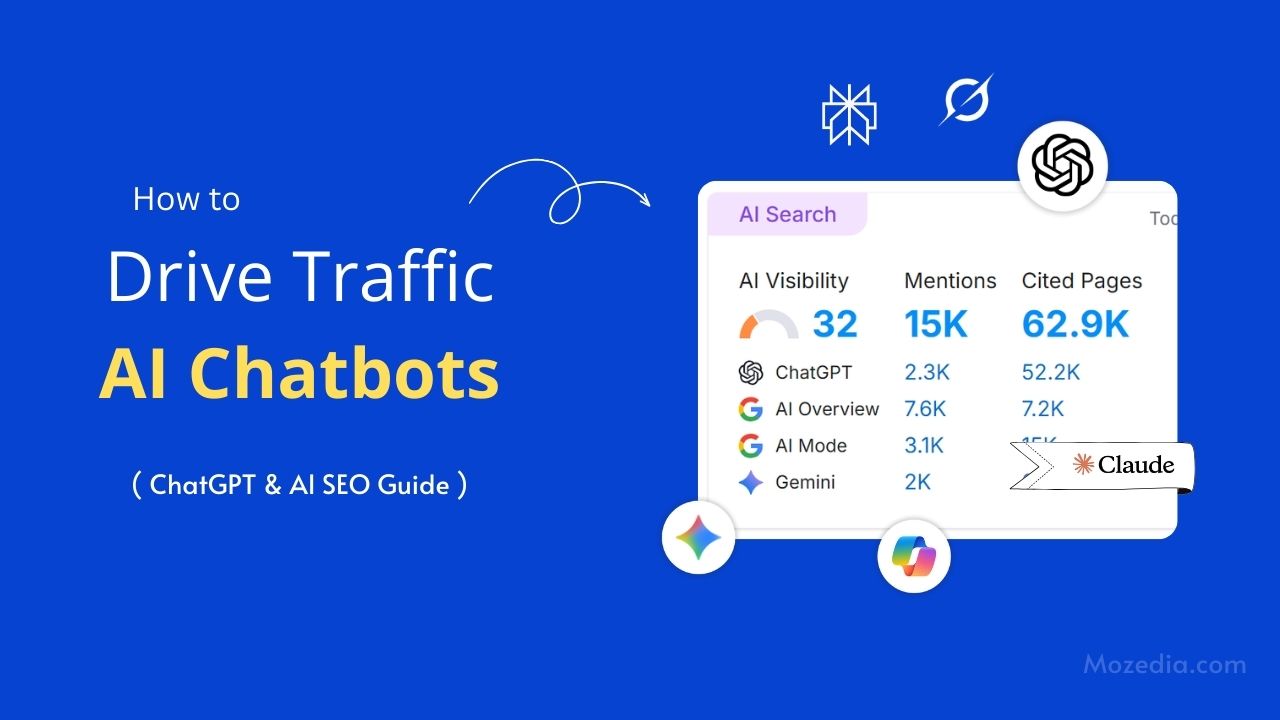
This is the age of AI, and the way we search for information on the internet has completely changed. AI chatbots are now providing more accurate and direct answers than search engines.
Previously, people used to rely on Google for answers to every question, now they ask AI chatbots, which helps users get the info they need without visiting any website.
This shift hasn’t just changed user behavior, it’s also created new opportunities for website traffic. Now you can’t just rely on Google, you have to focus on AI traffic.
I realized this change when ChatGPT mentioned my articles in their replies, and my website started receiving unexpected visitors. That’s why I’m writing this article for you.
If you are new to blogging and want to understand the basics of SEO, read this first:
- How to Start a Blog in 10 Easy Steps (Beginner Guide)
- How to Automate Your SEO In 2026 (10 Proven Ways)
This guide is specifically for webmasters, bloggers, website owners, and digital marketers who want to get traffic from AI chatbots in 2026.
Next, you’ll learn:
- What is AI SEO
- How AI chatbots recommend websites
- How to get your site cited in AI answers
- How to change your content strategy to get AI traffic
If you want to understand future-ready SEO, this guide is for you.
After reading this step-by-step guide, you will understand what changes you need to make to your content strategy to get AI chatbot traffic. – Jumedeen Khan
In short, AI Chatbot Traffic Definition:
AI chatbot traffic refers to visitors who arrive at your website after AI tools like ChatGPT or Perplexity mention or cite your content.
AI search is not replacing Google, it’s replacing how users discover websites. Let’s learn in detail:
- What Is AI Chatbot Traffic?
- Why You Need to Focus on AI Traffic?
- How AI Tools Send Visitors to Websites?
- How do AI Chatbots Recommend Websites?
- Why Are Certain Sites Cited in AI Answers?
- What is AI SEO and How to Get Rank In AI Answers?
- 10 Proven Ways to Get More Referral Traffic From AI Chatbots in 2026
- 1. Create Clear, Expert-Level Content
- 2. Provide Direct and Clear Answers to Questions
- 3. Optimize for Conversational Queries
- 4. Build Topical Authority
- 5. Use Structured Headings and FAQs
- 6. Earn Mentions from Trusted Sources
- 7. Strengthen E-E-A-T Signals
- 8. Publish Data and Unique Insights
- 9. Optimize for Featured Snippets
- 10. Keep Content Updated
- How to Optimize Content for ChatGPT and AI Citations
- How AI Chatbots Send Referral Traffic to Your Website in 2026?
- Common Mistakes That Block AI Traffic
- AI Search Trends That Will Shape Traffic in 2026
- The Future of SEO: Preparing for AI-Driven Search
- Common Questions About AI Chatbot Traffic
- Conclusion
What Is AI Chatbot Traffic?
AI chatbot traffic means when a user asks a question in AI tools like ChatGPT and your website name or link appears in response to that AI and they visit your site through it.
This traffic is different from traditional Google organic traffic. Your ranking in Google depends on the SERP and the user manually clicking through to reach your website.
But in AI chatbot traffic, the AI itself decides which website is trustworthy and should be included in its response and different chatbots can cite your site in different ways.
Here traditional keyword ranking is not as important as content quality, authority and accuracy. This is why generative engine optimization is essential for getting AI traffic.
In simple words:
When ChatGPT says “Check out mozedia.com for more information on this topic” or references your article in its reply, the traffic coming from there is called AI chatbot traffic.
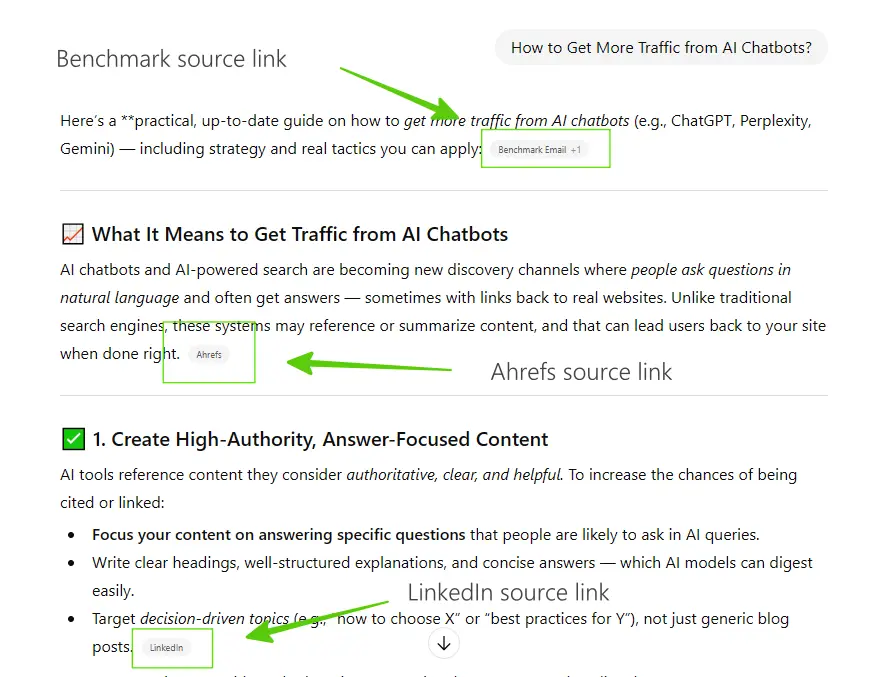
For example, in the screenshot below, ChatGPT cited source links:
AI Mentions vs Referral Traffic
There are two types of AI traffic.
The first is AI Mention, when an AI includes your brand or website’s name in its answer, but doesn’t provide a clickable link.
This increases brand awareness and leads users to search for your brand on Google.
The second is Referral Traffic, when an AI tool (like Perplexity) provides a clickable link in its answer, and the user is directed directly to your website.
This traffic appears in Google Analytics as a referral source. Perplexity specifically lists the source in every answer, which increases referral traffic.
Why You Need to Focus on AI Traffic?
AI search isn’t just a trend anymore, it’s a reality in 2026. Millions of people are now asking AI chatbots for answers instead of searching on Google.
When these AI tools mention or link to a website in their answers, that’s where the real traffic comes from. With the right strategy, you can also be included in these answers.
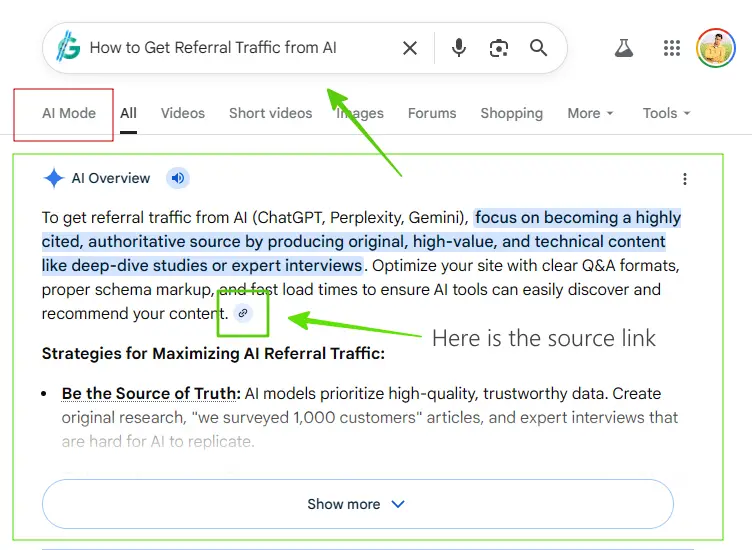
Google’s zero-click search has already reduced website clicks, and now its AI mode is accelerating this change. Google Gemini’s AI Overview provides direct answers.
See an example of the Gemini AI overview below:
How AI Tools Send Visitors to Websites?
This is crucial to understand, as your entire AI SEO strategy relies on it. AI language models are trained with vast amounts of data from across the internet.
AI systems are trained on a mixture of licensed data, publicly available information, and human-created content, and some tools also use real-time web retrieval.
In this process, websites that are reputable, frequently cited, and provide high-quality information gain greater weight.
When a user asks the AI chatbot a question, the AI generates answers based on its training data and real-time web search (as in the browsing modes).
In this process, the AI prioritizes sources whose content:
- Be clear and precise
- Be well-structured
- Be factually correct
- Demonstrate authority on the subject
Once the answers are generated, the AI cites these sources and sometimes displays them as ‘Learn more‘, ‘Sources‘, or clickable links.
This is where users reach your website.
AI Chatbots Key Insights:
ChatGPT’s base model primarily provides answers based on its training data, so it doesn’t always display live links. However, it can display web sources when browsing mode is enabled.
Perplexity.ai, on the other hand, performs live web searches for each question and includes clickable sources in its answers.
This has made Perplexity a significant source of referral traffic these days.
How do AI Chatbots Recommend Websites?
This is the most important part of this entire article.
If you understand the signals AI chatbots use to recommend websites, you can optimize those very factors to include your content in AI answers.
AI chatbots don’t cite random websites.
Complex algorithms operate behind them, analyzing content quality, source reliability, and semantic relevance.
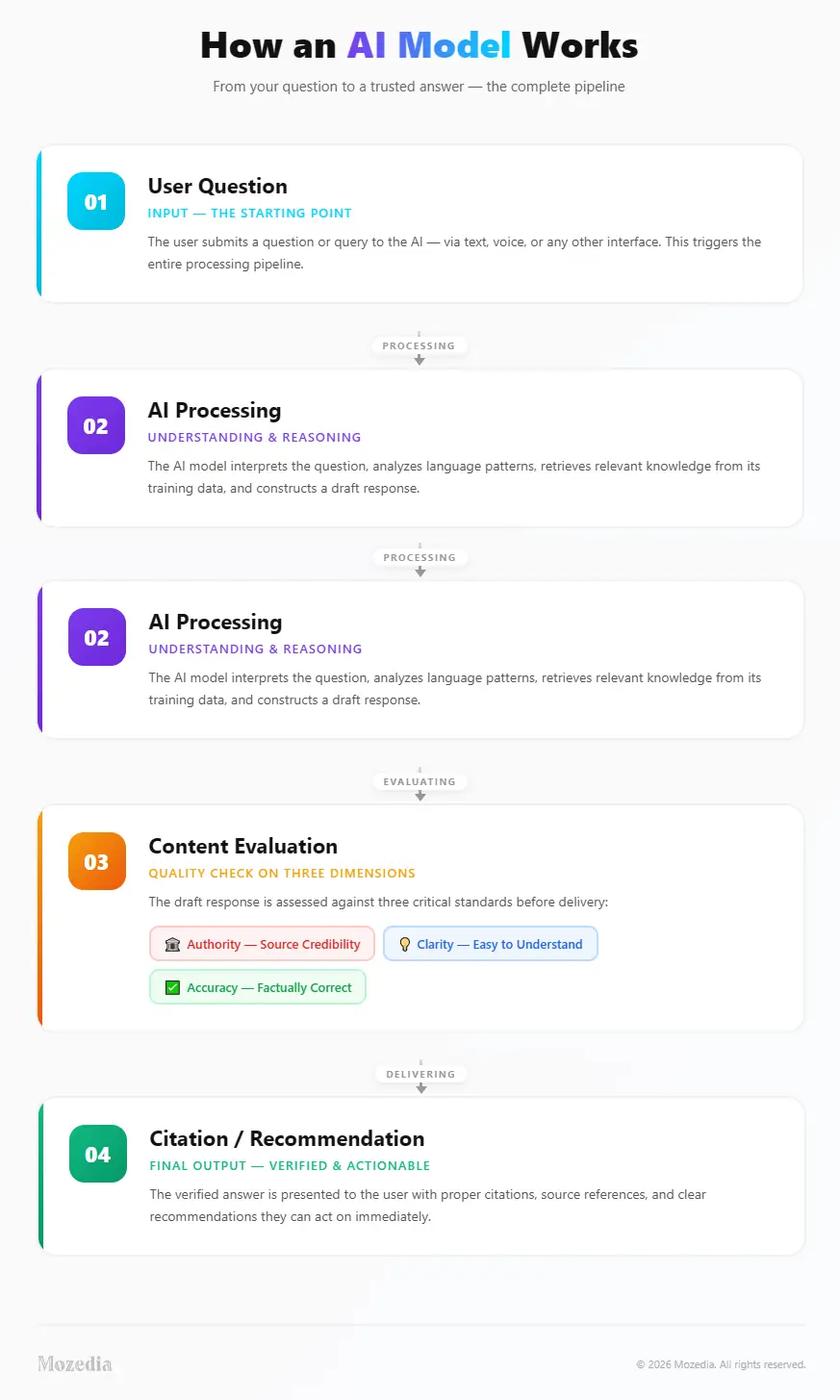
When ChatGPT, Perplexity, or other AI tools prepare answers on a topic, they prioritize websites that:
- Demonstrate genuine expertise on the subject
- Provide accurate and factual information
- Are presented in a clear and organized manner
- Provide a direct and useful answer to the user’s question
The goal of AI systems isn’t just to provide answers, but to provide reliable and contextual information.
So they choose sources users can trust.
Here is the simple infographic:
Why Are Certain Sites Cited in AI Answers?
I’ve personally observed this, and the same pattern emerges repeatedly in the SEO community: AI tools cite certain types of websites more frequently.
The reason for this isn’t just popularity, but the reliability, structure, and usefulness of the information.
1. Established and Trusted Authoritative Websites
The first category includes websites that have been trusted for years, such as Healthline, Investopedia, Wikipedia, or established brands like Neil Patel.
These sites are prioritized because:
- Their credibility is already established
- Subject matter expertise is clear
- The information is factual and regularly updated
- Other websites frequently cite them
AI systems prioritize trustworthy sources so that users get accurate information.
2. Websites that Provide Direct and Clear Answers
The second category includes sites that provide clear and straightforward answers to specific questions.
AI particularly appreciates content written in a question-and-answer format that doesn’t require the user to read the entire article to find the answer.
Content that:
- Is immediately useful
- Can be easily understood by AI
- Is suitable for snippets and AI answers
3. Sites that Publish Original Data and Unique Insights
The third category includes websites that publish original data, research, case studies, or unique insights.
If your content provides information that isn’t readily available on the internet, AI considers it a more valuable source.
This could include:
- Own experiments or case studies
- Industry-related data
- Surveys or analyses
- Findings based on real-world experiences
How Might Your Website Fit Into these Categories?
If you want AI tools to cite your website, you need to make your content more specific and topic-focused, directly answer questions, and based on data and real-world experiences.
The goal of AI search is not just to provide information, but to provide the most reliable and useful answers to the user and the more useful your content is, the more likely it will be included in AI answers.
The Role of Authority and Trust Signals
When AI models are trained, they are fed vast amounts of data from the internet. This process naturally includes more content from high-authority websites, as they have been considered credible sources for years.
For this reason, AI tools more frequently cite websites that have strong backlink profiles, are referenced by other authoritative websites, and have an established reputation in their industry.
AI systems don’t just look at information; they also assess the source’s credibility.
Important Trust Signals:
The following signals give both AI and users confidence that a website is authentic and trustworthy:
- A credible author profile with genuine qualifications
- A clear “About Us” page that provides information about the website and team
- Contact information that demonstrates transparency
- A regular and consistent content publication history
- A secure website (HTTPS) and professional design
All of these signals help AI understand that the source is trustworthy and provides accurate information to users. If you want to increase the authority of your website, this guide will be helpful.
Additionally, ChatGPT citations and AI recommendations typically go to websites that consistently publish high-quality content and have a strong backlink profile.
Simply put, the more trust your website has, the more likely AI tools are to include it in their answers.
What is AI SEO and How to Get Rank In AI Answers?
AI SEO is a new emerging discipline that differs significantly from traditional SEO.
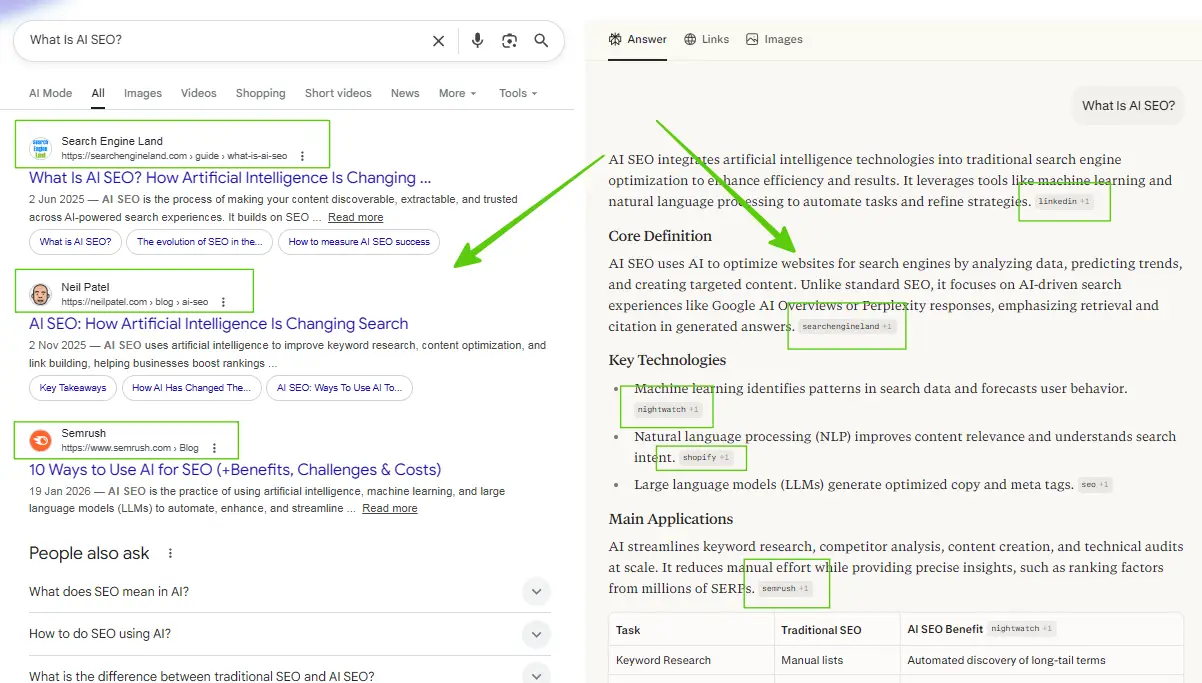
In traditional SEO, you focus on improving rankings for specific keywords, optimizing meta tags, building backlinks, and satisfying search engine algorithms.
In contrast, the goal of AI SEO is to make AI language models understand and trust that your content provides the most accurate, useful, and reliable answers to a topic.
It’s also called LLM SEO (Large Language Model SEO) or Generative Engine Optimization (GEO).
In simple terms, it means optimizing your content so that AI models choose it as their primary source for training data and during real-time searches.
Traditional SEO vs. AI SEO
Success in traditional SEO meant ranking on the first page of Google. Keyword research, title optimization, exact-match keywords, and backlinks played a crucial role in this.
This approach is still effective today, but it’s no longer sufficient alone. Success in AI SEO means receiving a citation or recommendation in AI answers.
Here is the comparison table of SEO vs AI SEO:
| Factor | Traditional SEO | AI SEO (GEO) |
|---|---|---|
| Primary Focus | Keywords & search rankings | Context, authority & semantic relevance |
| Main Goal | Rank on search engine results pages (SERPs) | Get cited, referenced, or recommended in AI answers |
| Content Style | Keyword-optimized pages | Expert, comprehensive & answer-focused content |
| Ranking Signals | Backlinks, keywords, technical SEO | Trust, clarity, authority & factual accuracy |
| User Intent Handling | Matches search queries | Understands intent & delivers complete answers |
| Optimization Approach | On-page & link building | Contextual depth & entity relevance |
| Visibility Placement | Blue links & featured snippets | AI answers, citations & source panels |
| Traffic Source | Organic search clicks | AI referrals & brand mentions |
| Content Structure | Optimized for crawlers | Structured for AI understanding & extraction |
| Long-Term Advantage | Ranking improvements | Authority recognition & trust amplification |
The authenticity of the entire topic is more important here than a single keyword. Semantic relevance and context become more important than exact keyword matching.
Content written in a conversational tone, naturally answering user questions, proves more effective in AI SEO.
A practical example:
In traditional SEO, you try to rank for the keyword “best WordPress hosting.” But in AI SEO, you write a comprehensive guide that explains:
- What to consider when choosing WordPress hosting
- How to compare different hosting types
- Which hosting is suitable for which user
This kind of detailed, helpful, and contextual content appears more useful to AI.
If you want to understand the process of choosing a hosting, this guide is useful: 10 Best WordPress Hosting Providers (Editor’s Pick 2026).
How does AI Understand the Context of Content?
AI models understand content differently than traditional search engines.
While Google’s algorithms focused on keywords, backlinks, and technical signals, AI models use semantic understanding.
This means:
- Understanding the actual meaning of content
- Recognizing relationships between entities
- Understanding the accuracy and context of information
This is where Entity SEO becomes extremely more important, and entities are identifiable real-world concepts, such as:
- “Jumedeen Khan” a person entity
- “mozedia.com” a website entity
- “WordPress SEO” a concept entity
When your website is consistently linked to these entities, AI is more likely to reference your site when answering a topic.
Use Structured Data and Schema Markup
Adding schema markup provided by schema.org (structured data) to your website content helps search engines and AI tools clearly understand:
- Who you are?
- What your website is about?
- What your organization and expertise are?
This clarity increases the likelihood of AI trust and citation.
10 Proven Ways to Get More Referral Traffic From AI Chatbots in 2026
The strategies I’m sharing here, I’ve personally tested and seen their results. Start implementing them into your content strategy, and you’ll see AI tools gradually start citing your website.
It’s also important to understand that getting traffic from an AI chatbot isn’t an overnight process. It’s a long-term strategy, with results typically visible in 3 to 6 months.
However, bloggers who start working on it now will be at a significant advantage in the long run.
1. Create Clear, Expert-Level Content
AI chatbots prioritize websites that demonstrate genuine expertise on a topic. Thin, generic, or copied content is virtually useless to AI.
If you want your content to be included in AI answers, you must write content that provides a complete, accurate, and contextualized answer to a specific question.
Expert-level content doesn’t mean using difficult or complex language. It actually means delving into the subject and presenting information that isn’t found in typical articles.
To do this, you can:
- Share your personal experiences
- Include real examples
- Provide step-by-step solutions
- Explain common mistakes and their solutions
- Add information that is genuinely useful to readers
When AI systems recognize that an article contains unique insights and first-hand knowledge, they consider it a more credible and quotable source.
In simple terms, if your content provides “real guidance” and not “just information”, AI prioritizes it.
2. Provide Direct and Clear Answers to Questions
AI chatbots are fundamentally question-answering systems. Their primary goal is to deliver the most accurate and useful answers to user queries.
Therefore, the more your content is structured around questions and provides direct answers, the more likely AI systems are to include it in their responses.
A highly effective strategy is to begin each article with a clear 2–3 sentence answer to the main question.
This approach follows the journalistic inverted pyramid style, where the most important information appears first, followed by supporting details.
In addition, writing your subheadings as questions can be extremely beneficial. For example:
- What is AI SEO?
- How is AI SEO different from traditional SEO?
Questions like these address user intent more precisely and make it easier for AI systems to extract clear answers.
This approach also increases your chances of appearing in Featured Snippets and the People Also Ask section.
If you want to explore this topic in greater depth, read this guide:
In short, when your content provides clear, direct answers to questions, it becomes more valuable not only for users but also for AI systems.
3. Optimize for Conversational Queries
People interact with AI chatbots the same way they speak to another person. Instead of typing short keywords like “best SEO tips,” they ask full questions such as:
How can I do SEO for my new website to get traffic quickly?
This is known as a conversational query and AI search is built on natural language processing.
If your content mirrors the way people naturally ask questions, AI systems can understand it more easily and are more likely to include it in their answers.
Include such questions in your articles and provide clear, direct responses. Identify long-tail conversational queries and offer detailed solutions tailored to real user intent.
You can structure your content using the Who, What, Why, How, When, Where framework.
For example:
- What is SEO and why is it important?
- When should you start SEO for a new website?
- Which strategies are most effective for increasing website traffic?
- How can beginner bloggers implement SEO?
This structured, conversational format addresses real user questions and makes it easier for AI systems to extract precise answers.
Voice search optimization is also part of conversational SEO. When users ask questions through mobile devices or smart assistants, they speak in complete sentences just as AI chatbots.
In short, if your content answers real user questions in a natural, conversational tone, its chances of being included in AI-generated answers increase significantly.
4. Build Topical Authority
Topical authority means publishing such comprehensive and in-depth content on a specific niche or subject that AI systems begin to recognize your website as an expert source.
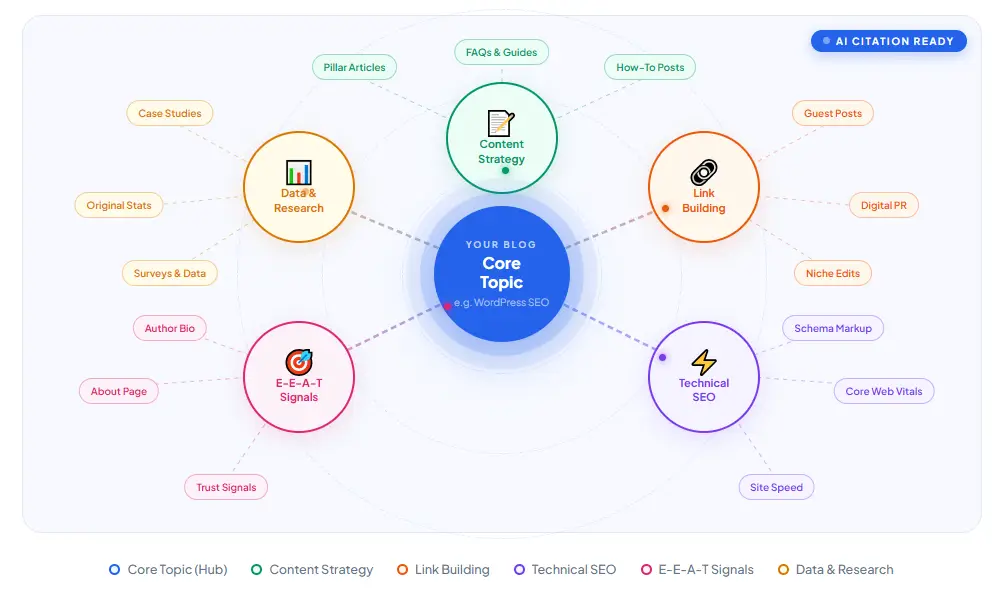
In AI SEO, a network of 20–30 detailed, interconnected articles on a topic is far more effective than a single viral post.
This signals that your website covers the subject thoroughly rather than superficially.
For example:
If you are working on WordPress SEO, publishing only a “WordPress SEO guide” is not enough. Instead, you should cover related subtopics in depth, such as:
- Yoast SEO setup
- Website speed optimization
- Schema markup implementation
- Internal linking structure
- Crawl errors and indexing issues
When AI systems detect that a website systematically covers every important aspect of a topic, they begin to treat it as an authority within that niche.
Topical authority not only increases the likelihood of AI citations but also improves Google rankings, builds user trust, and supports backlink acquisition.
If you want to understand strategies for ranking without backlinks and building topical authority, read this guide:
In short, the more depth and consistency you bring to covering a subject, the more strongly AI systems and search engines will recognize you as an expert in that field.
5. Use Structured Headings and FAQs
Content structure is critically important for AI systems.
When your article is organized with clear H1, H2, and H3 headings, it becomes easier for AI to understand which subtopics your content covers.
A well-structured layout not only improves readability but also helps AI identify specific sections of your article and reference them in responses.
When each section is clearly defined, AI systems can quickly extract relevant information. Adding an FAQ section either at the end or within the article is especially beneficial.
The FAQ format is ideal for AI systems because it presents clear question–answer pairs that can be used directly in generated responses.
When creating FAQs, keep the following in mind:
- Base questions on real user queries
- Keep answers concise, clear, and accurate
- Provide one clear answer per question
Implementing FAQ schema (structured data) makes this even more effective. It helps search engines and AI tools better understand your content structure and context.
This strategy not only increases the likelihood of AI citations but also improves your chances of appearing in Featured Snippets and voice search results.
6. Earn Mentions from Trusted Sources
The more your website is mentioned or referenced by authoritative and trustworthy sites, the more likely AI systems are to recognize it as a reliable source.
This differs slightly from traditional link building here, the quality, relevance, and context of mentions matter more than sheer backlink volume.
AI tools assess your credibility across the web.
When your brand is referenced by trusted publications, industry experts, or reputable platforms, it sends a strong signal that your content is reliable and worthy of citation.
You can earn trusted mentions through:
- Guest posting on reputable websites
- Participating in podcast interviews or expert discussions
- Creating collaborative or co-authored content
- Contributing to industry reports and research studies
- Providing expert quotes for publications
When high-authority platforms such as Wikipedia, Forbes, or niche-specific authority websites mention your brand, it becomes a powerful trust signal indicating real expertise in your field.
If you want to start building mentions and backlinks, this list may help:
In short, the stronger and more credible your presence across the web, the more likely AI tools are to include your website in their answers.
7. Strengthen E-E-A-T Signals
These signals are defined in Google’s Quality Rater Guidelines, and modern AI systems also rely on similar principles to evaluate content credibility.
If you want AI tools to recognize your website as a trustworthy source, strengthening all four signals is essential.
1. Show Experience
To demonstrate real-world experience:
- Share first-hand insights and practical learnings
- Publish case studies
- Show real results and examples
- Include “how I did it” explanations
2. Demonstrate Expertise
To highlight subject expertise:
- Add a detailed author bio
- Clearly state qualifications and experience
- Showcase subject-specific professional background
3. Build Authoritativeness
To establish authority:
- Get featured on industry-related websites
- Write guest articles
- Build brand recognition within your niche
4. Ensure Trustworthiness
To improve trust signals:
- Maintain transparent privacy policy and terms pages
- Provide clear contact information
- Publish accurate and regularly updated content
- Use HTTPS and maintain a secure, professional website
Together, these signals assure AI systems that your website is authentic, reliable, and safe for users, meaning the more trust your website builds, the more likely AI tools are to include it in their answers.
8. Publish Data and Unique Insights
AI chatbots prefer to cite statistics, research findings, and unique data because such information is specific, verifiable, and highly credible.
If you publish original surveys, case studies, or industry reports on your website, the likelihood of AI systems citing your content increases significantly.
Data-driven content signals that you are not merely sharing generic information, but presenting real analysis and research.
You don’t need large-scale studies to do this, even small experiments can provide valuable insights. For example:
- Track the performance of different content formats
- Record results after implementing SEO changes
- Share real traffic growth data
- Show before-and-after results of a strategy
For instance, I once conducted an experiment tracking which types of articles AI tools cite more frequently and published the findings.
This original data was not available elsewhere online.
Content built around unique insights like these is highly valuable for AI systems because it provides fresh, useful, and evidence-based information.
In short, when you share data-backed conclusions and experience-based insights, your content becomes not only worth reading but worth citing.
9. Optimize for Featured Snippets
There is a strong connection between featured snippets and AI citations. Pages that earn featured snippets in Google search are often cited in AI-generated answers.
This happens because both Google and AI systems rely on similar criteria, clear answers, structured formatting, and trustworthy sources.
The goal of featured snippet optimization is to present the most concise and accurate answer to a user’s question.
To improve your chances, follow these best practices:
- Include the question in a heading
- Provide a clear answer in about 40–60 words
- Use ordered or unordered lists where appropriate
- Present definitions clearly
- Provide step-by-step processes in structured form
- Use comparison tables when explaining differences
Definition boxes, comparison tables, and step-by-step guides are especially snippet-friendly formats because they make information quick and easy to understand.
Content optimized for featured snippets not only improves visibility in Google search but also provides AI systems with clear, citable answers.
Additionally, gaining traffic from Google Top Stories can strengthen your traffic diversification strategy. To explore this further, read this guide:
In short, when your content delivers clear, structured, and concise answers, its chances of appearing in both featured snippets and AI citations increase significantly.
10. Keep Content Updated
AI chatbots prioritize fresh and relevant information. Outdated content not only becomes less useful for users but may also be considered less reliable by AI systems.
If you want your content to be included in AI-generated answers, regularly reviewing and updating important articles is essential.
For best results:
- Review key articles every 3–6 months
- Update outdated statistics, tools, and processes
- Remove broken links and obsolete references
- Add new examples and fresh insights
Displaying a “Last Updated” date on your article is also important. It signals to both AI systems and users that the information is current and trustworthy.
In addition to maintaining evergreen content, publishing timely articles on trending topics can be highly beneficial. AI tools often prioritize recently published, relevant content, especially when a topic is evolving quickly.
Publishing frequency also plays a role. Websites that consistently publish high-quality content are more likely to be recognized by AI systems as active, reliable, and up-to-date sources.
In short, regular updates keep your content relevant, improve trust, and increase the likelihood of AI citations and long-term traffic growth.
How to Optimize Content for ChatGPT and AI Citations
So far, we’ve understood what AI chatbot traffic is and the principles behind it. Now it’s time to explore the specific optimization techniques that make your content AI-citation-worthy.
This optimization is similar to traditional SEO in some ways, but the approach shifts. In the past, we often wrote with search engine bots in mind.
For AI systems, you should write as if a knowledgeable expert is clearly and accurately explaining a topic.
1. Write Direct and Accurate Answers
When a user asks a question, AI needs an answer it can present immediately.
Therefore, each main question in your content should have a clear and direct answer ideally at the beginning of the paragraph.
For example, if the question is:
What is AI SEO?
Start the answer like this:
AI SEO is the process of optimizing your website so that AI tools like ChatGPT can recommend and cite it in their answers.
This direct approach creates content that AI can easily extract and present.
2. Use Simple Language and Clear Structure
AI systems prioritize clear, informative writing over complex or decorative language. Use technical jargon only when necessary and always explain it.
To improve readability:
- Keep paragraphs short
- Focus on one idea per paragraph
- Use transition words for flow
- Write clear, simple sentences
Maintain a logical structure:
- Explain the concept
- Provide an example
- Show practical application
This sequence makes content easier for both users and AI to understand.
3. Include Statistics and Credible Sources
AI tools prioritize verifiable data. When mentioning statistics, include the source. Specific, source-backed information is highly valuable for AI systems.
For example:
According to Techcrunch, Google Gemini surpassed 750 million monthly active users in Feb 2026.
Link to reputable sources such as industry reports, official websites, and research studies. This strengthens credibility for both AI systems and users.
Opening external links in a new tab also improves user experience.
Use Schema and Structured Data
Schema markup (structured data) is special code added to your website that helps search engines and AI tools clearly understand your content and its context.
FAQ schema makes your question–answer pairs easily extractable. Article schema helps AI understand publication date, authorship, and topic relevance.
Schema types especially useful for AI visibility include:
- FAQ schema
- Article schema
- HowTo schema
- Organization schema
You can use Schema Markup Validator to validate schema markup.
Here’s an example FAQ schema:
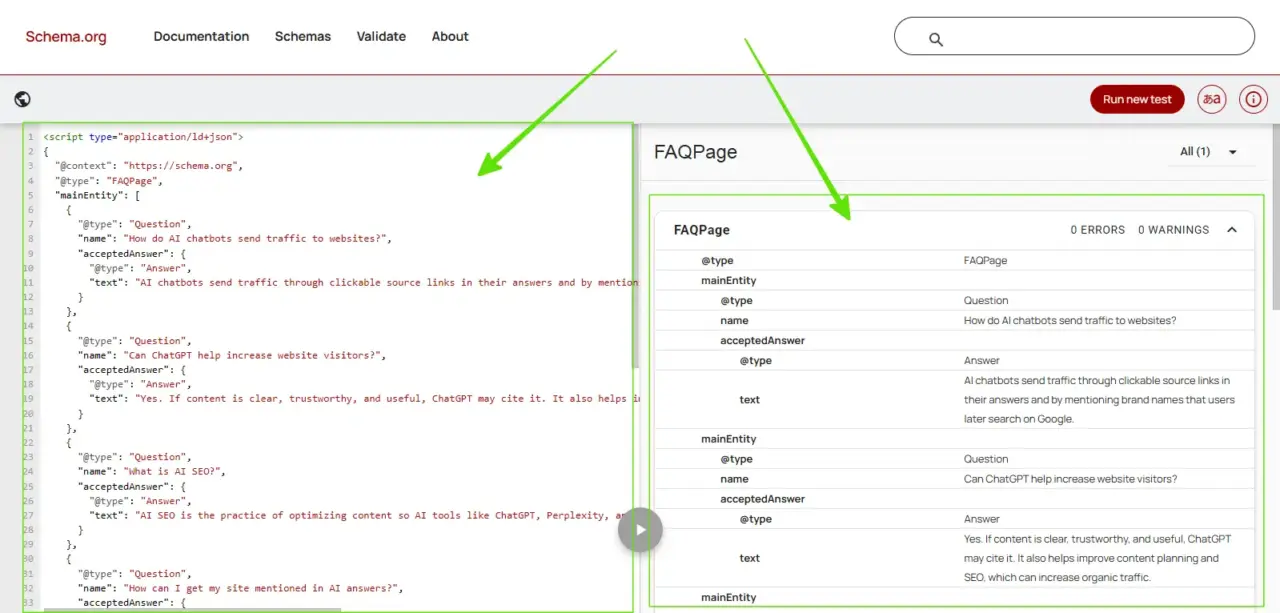
If you use WordPress, plugins like Yoast SEO or Rank Math make schema implementation simple.
To learn step-by-step schema setup, see this guide:
If your content provides clear answers, uses simple language, includes credible data, and is structured properly, its chances of appearing in AI-generated answers increase significantly.
How AI Chatbots Send Referral Traffic to Your Website in 2026?
In 2026, understanding the flow of AI traffic is important not only from an SEO perspective but also from an analytics standpoint.
When you review referral traffic in Google Analytics, you may notice visitors arriving from various AI platforms, such as ChatGPT, Gemini, Copilot, Grok etc.
Here is a screenshot of my website’s referral traffic analytics.
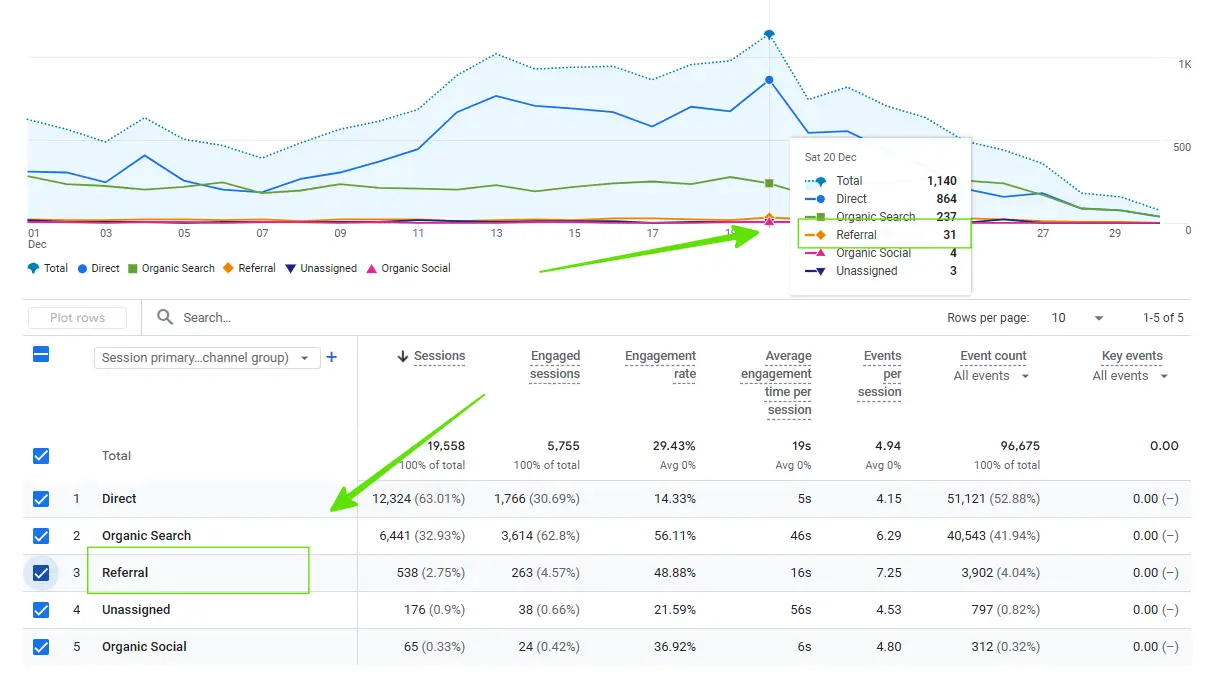
This data provides clear insight into which AI tools are referring the most users and what type of content is earning citations.
Major Sources of AI Referral Traffic
Common platforms that can send visitors to your site include:
- perplexity.ai: often provides highly clickable source links
- chat.openai.com: via ChatGPT browsing-based responses
- gemini.google.com: through Google Gemini answers
- bing.com/chat: Microsoft Copilot responses
- you.com: AI-powered search answers
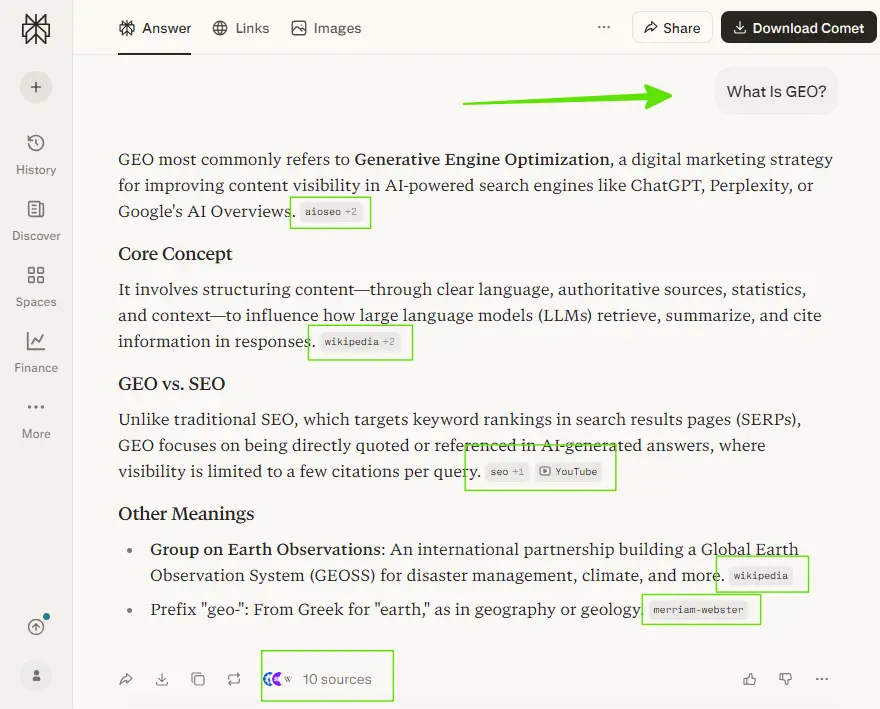
The greater your visibility across these platforms, the more referral traffic your website can receive. Here you can see Perplexity answer screenshot with mention source sites.
How to Increase Clicks from AI Answers?
Being cited in AI answers is not enough, users must also click through to your website.
A recognizable brand name increases click probability. When users see a domain they recognize or trust, they are more likely to visit it.
To improve click-through rates:
- Build a strong, memorable brand
- Publish trustworthy, expert-level content
- Maintain consistent presence within your niche
- Use a headline analyzer to write catchy titles
Optimizing meta descriptions and content previews is also important. Some AI tools, such as Perplexity, display short summaries alongside source links.
If your meta description clearly communicates the value users will gain, it can improve click-through rates.
Structured data can also help AI tools generate better previews of your content.
Optimize Content for Citation Links
AI tools typically cite paragraphs or sections that provide clear, direct answers to specific questions. Create snippet-ready sections that stand alone and fully address a specific query.
When writing these sections:
- Use precise, factual language
- Avoid ambiguous phrasing
- Provide clear, concise definitions
- Use numbered steps for processes
- Ensure each answer is independently useful
Write them in an encyclopedia-like style, clear, reliable, and easy to reference.
Practical Tip: Learn from AI Source Analysis
Search niche-related questions on Perplexity or similar AI tools and observe which websites appear as sources.
Pay attention to:
- Depth of content
- Answer style and clarity
- Structure and formatting
- Use of data and examples
This process acts as competitive research and helps you understand the type of content AI systems prioritize.
Understanding and optimizing for AI referral traffic can bring new visitors to your website while positioning your brand strongly in the emerging AI-driven search ecosystem.
Common Mistakes That Block AI Traffic
Knowing what to do to gain AI traffic is important but understanding what not to do is equally critical. These mistakes are extremely common, and in my early days I made several of them myself.
If your website isn’t receiving AI traffic yet, or only getting very little, the reasons may lie in the points below.
1. Thin and Generic Content
This is the most common and most damaging mistake.
Many bloggers focus on quantity and publish surface-level articles that repeat information already available across thousands of websites.
AI tools can easily recognize such content and avoid citing it.
For example:
If you publish a 500-word article on “What is AI Traffic?” containing the same information found on Wikipedia, AI systems will likely ignore it.
Instead, choose specific, value-driven topics such as:
“What Is AI Traffic? How to Get Traffic from AI Chatbots: A Complete AI SEO Guide for 2026”
This type of content is useful, analytical, and citation-worthy.
Creating value-driven content is one of the most critical blogging lessons I’ve learned over the years, and AI can summarize facts, but it can’t replicate personal wisdom.
2. Lack of Authority Signals
If your website lacks author information, has an incomplete About page, and is not mentioned or linked by other websites, AI systems have little reason to trust it.
Anonymous content can be a red flag.
Give your website a clear digital identity:
- Add author bylines
- Create a professional About page
- Clearly state your expertise and experience
- Stay active within your industry
- Maintain a social media presence
- Use consistent branding
When people and websites recognize you, AI systems begin to recognize your credibility as well.
3. Poor Structure and Formatting
If your content appears as one long block of text without headings, subheadings, lists, or visual breaks, AI systems may struggle to extract important information.
Proper structure improves readability and helps AI understand your content.
To improve formatting:
- Add a heading or subheading every 150–200 words
- Bold important information
- Use lists and tables where appropriate
- Maintain sufficient whitespace
This formatting also improves user experience.
A slow website can also become a hidden barrier to AI traffic.
To improve speed, see:
4. Over-Optimized Keyword Stuffing
In early SEO, keyword stuffing, repeating the same keyword excessively was common. In AI SEO, this approach has the opposite effect.
AI language models understand natural language and treat keyword-stuffed content as a low-quality signal.
A better approach:
- Use the primary keyword naturally 2–4 times
- Include related terms and synonyms
- Keep language natural and readable
For example, when writing about AI SEO, related phrases such as LLM SEO, AI search optimization, and generative AI optimization will naturally appear.
This semantic richness makes your content more natural and valuable. You can use our keyword suggestion tool to find relevant keywords for your content.
Adopting the right strategies is essential for gaining AI traffic, but avoiding these common mistakes is just as important.
Remember, your small improvements can significantly enhance your website’s credibility, visibility, and performance in AI-driven search environments.
AI Search Trends That Will Shape Traffic in 2026
The search landscape is evolving rapidly in 2026, and this transformation is expected to accelerate over the next 2–3 years.
If you understand these changes now and adjust your strategy accordingly, you can position yourself among the bloggers and website owners who benefit the most from this shift.
Below are the key trends that will directly influence your traffic strategy — along with what you should do to adapt.
1. The Growing Impact of AI-First Search Behavior
AI-first search behavior is becoming dominant. People are no longer using AI tools as simple assistants; they are becoming primary research tools.
According to Gartner research, traditional search engine queries could decline by around 25% by 2026.
This doesn’t mean Google will disappear, it signals the growing importance of diversified traffic sources.
What you should do:
- Don’t rely solely on Google
- Create AI citation–friendly content
- Build brand authority and topical expertise
2. Rise of Voice and Conversational Search
Smart speakers, mobile voice assistants, and AI chatbots all rely on conversational queries. People now ask complete questions instead of typing short keywords.
Example:
- blogging income
- How can I earn money from blogging in 2026?
These full-sentence queries differ from traditional search and require conversational SEO.
What you should do:
- Write question-based headings
- Use conversational language
- Include voice-search-friendly answers
3. Expansion of the Zero-Click Ecosystem
Zero-click search began with featured snippets, but AI has expanded it significantly. Users can now receive complete answers without visiting a website.
Studies from SparkToro show that a significant percentage of searches now end without a click, highlighting the importance of alternative traffic sources.
There’s no need to panic.
The solution isn’t withholding information, it’s creating content that encourages users to visit your site for deeper understanding.
What you should do:
- Publish comprehensive guides
- Provide advanced insights and real examples
- Deliver actionable content
4. Increasing Influence of Personalized AI Answers
In 2026, AI tools are increasingly delivering personalized answers based on user history, preferences, and location.
This makes brand recognition and user loyalty more important than ever.
Users who have previously visited your site may see your content more prominently in AI-generated answers.
What you should do:
- Build a strong brand identity
- Increase repeat visitors
- Grow an email list and community
- Develop trust and loyalty
AI-driven search is moving toward personalization, authority, and trust.
Websites that build relationships with their audience will gain stronger visibility in the AI-powered ecosystem.
To understand the real future of blogging in the AI era, read:
AI search is not just a technical shift, it is redefining user behavior, content strategy, and the future of traffic sources for websites.
Those who prepare now will lead the future.
The Future of SEO: Preparing for AI-Driven Search
SEO is not dying, it is evolving. We’ve heard this for years, and in the age of AI it has never been more true, don’t understand? Let me explain.
Ranking on Google remains important and will continue to matter, but a new dimension AI visibility has emerged, and ignoring it could be costly.
Search behavior is shifting from keywords to conversations. Earlier, users typed short phrases like:
“blogging tips”
Now they ask:
“I’m a new blogger and want to earn $10,000 per month through part-time blogging, where should I start?”
Understanding user intent is key to monetization. In fact, adapting to these shifts is exactly how I made $10,000 with blogging despite the rise of AI tools.
That means, AI tools are far better at understanding the context behind such conversational queries and delivering useful answers.
1. Brand Authority Is More Important Than Ever
In the AI era, brands and websites that have become trusted names appear consistently in AI answers. This can be seen as a first-mover advantage.
If you start now by:
- publishing high-quality content consistently
- building partnerships and collaborations
- earning digital PR and mentions
you are laying a strong foundation for future AI visibility.
2. Trust and Expertise Signals Will Matter Even More
As AI systems become more advanced, they will get better at recognizing and rewarding E-E-A-T signals (Experience, Expertise, Authoritativeness, Trustworthiness).
High-performing content in the future will feature:
- content written by real experts
- experience-based insights
- verifiable credentials
- transparent author identity
In contrast, anonymous and faceless websites will gradually lose credibility.
3. Technical Foundation Is Equally Important
AI visibility doesn’t depend on content alone, your website’s technical quality also plays a crucial role.
Ensure your site is:
- fast loading
- mobile-friendly
- secured with HTTPS
- structured cleanly and logically
These factors help not only with Google rankings but also enable AI crawlers to gather real-time information efficiently.
If you want to improve productivity and AI integration, this list may help:
The future of SEO goes beyond keywords. It will be driven by trust, authority, conversational relevance, and technical excellence.
Websites that begin adapting today will gain the greatest visibility and traffic in the AI-driven search ecosystem of tomorrow.
Common Questions About AI Chatbot Traffic
When discussing AI chatbot traffic, readers often have similar questions. The answers below clarify the most common concerns.
How do AI chatbots send traffic to websites?
AI tools send traffic in two main ways. First, they display clickable source links within their answers, allowing users to visit a website directly (referral traffic).
Second, AI may mention your brand name, prompting users to later search for it on Google and reach your site.
Can ChatGPT help increase website visitors?
Yes. If your content is trustworthy, clear, and useful, ChatGPT may cite it in its answers.
Additionally, ChatGPT can help with content planning, SEO improvements, and content optimization, which can indirectly increase organic traffic.
What is AI SEO?
AI SEO is the process of optimizing content so that AI tools such as ChatGPT, Perplexity, and Google Gemini can recommend or cite it in their answers.
Content clarity, authority, structured data, and conversational optimization all play important roles.
How can I get my site mentioned in AI answers?
Publish high-quality, in-depth content in your niche, add FAQs and schema markup, earn mentions from authoritative websites, and update your content regularly.
Also analyze which sites appear in AI answers and aim to provide more useful and comprehensive information.
Is AI traffic better than Google traffic?
Both are important. Google traffic still delivers higher volume, while AI traffic is growing rapidly and tends to be more targeted.
Over the long term, balancing both sources will strengthen your traffic strategy.
Do AI tools provide referral traffic?
Yes. Perplexity.ai often provides the most clickable source links. Microsoft Copilot and Google Gemini also display sources, while ChatGPT’s browsing-based responses may show sources in certain cases.
These visits typically appear as referral traffic in Google Analytics.
What is the long-term impact of AI on blogging?
AI will reduce the value of generic informational content but increase demand for personal experience, unique insights, and expert-level guidance.
Always remember, bloggers who maintain authenticity, originality, and real expertise will continue to succeed in the AI era.
🚀 Essential Free Tools for AI SEO:
Ready to optimize? Use our free Keyword Generator to find conversational queries and the Headline Analyzer to increase your click-through rates.
Conclusion
In this guide, we explored what AI chatbot traffic is and how it works. We examined the signals ChatGPT, Perplexity, and other AI tools use to recommend websites.
We covered 10 proven strategies to make your content citation-worthy, identified common mistakes that block AI traffic, and discussed future trends shaping the search landscape.
AI Chatbots Are the Future Traffic Engine of 2026. We are standing at a turning point in the digital world, one as significant as the early days of the internet revolution.
Search is evolving, and websites that adapt to this change in time will gain a powerful competitive advantage in the years ahead.
Now comes the most important step — taking action.
Start today by reviewing your top five articles and ask:
- Are they AI-friendly?
- Do they provide clear, direct answers?
- Are the headings and structure well organized?
- Are author information and E-E-A-T signals strong?
- Is schema markup implemented?
If improvements are needed, begin updating them.
Remember, AI SEO is a marathon, not a sprint. But those who start consistently improving today will begin to see measurable results within the next 6–12 months.
For proven ways to make money blogging and from internet, read articles below:
The next chapter of the internet is AI-driven and your website deserves a meaningful role in it.
If you found this article helpful, consider sharing it and if you have questions about AI SEO, feel free to ask below, I do my best to respond personally.