
Moz vs Ahrefs: Which SEO tool is better? Today, I’ll explain both tools in a 10-step comparison and help you choose the right winner, as I’ve tested both of them myself.
Moz and Ahrefs, both platforms aim to improve search visibility, their strengths, data accuracy, feature sets, and overall approach to SEO differ significantly.
This makes it essential to clearly understand the Ahrefs vs Moz Pro debate and determine which tool best aligns with your specific SEO goals.
In this comparison, we analyze data-driven decision-making capabilities, features, usability, keyword research, backlinks audit, site audits, pricing, and 2026 SEO trends of both tools.
Introduction to Ahrefs and Moz Pro
Ahrefs is known for its high-quality SEO data, particularly in backlink analysis, keyword research, and competitor analysis. Its data index is constantly updated, making it ideal for in-depth SEO strategies.
Moz Pro is a stable and reliable SEO platform that offers accessible solutions for beginners and small/medium-sized businesses.
In my SEO projects, I’ve used both Moz and Ahrefs for content planning, backlink analysis, and competitor research, which gives me a practical perspective beyond just tool features.
It provides a simple and cost-effective experience with features like site audits, Domain Authority (DA), and basic SEO metrics.
Along with Moz and Ahrefs, there are several other SEO tools used by professionals for keyword research, competitor analysis, and site audits, such as Semrush, but here we will only compare Ahrefs vs. Moz Pro.
Quick note before reading:
This article is based on real-world SEO use cases and practical experience, so you can make informed SEO decisions instead of simply looking at tool features.
It doesn’t try to sell you any tool, but rather explains both based on real-world SEO performance, so you can choose the best tool for your SEO goals.
If you’re confused between Moz vs Ahrefs, this guide provides clear, practical, and data-driven answers, so read it carefully.
- Moz and Ahrefs: a quick overview
- Moz vs Ahrefs: In-Depth AI-Powered SEO Tool Comparison (2026)
- 1. Keyword Research Comparison
- 2. Moz vs Ahrefs: Backlink Analysis
- 3. Moz Domain Authority & Ahrefs Domain Rating
- 4. Ahrefs vs Moz: Site Audit SEO Comparison
- 5. Competitor Analysis & SERP Insights
- 6. Moz vs Ahrefs: Key Metrics
- 7. Moz vs Ahrefs: User Interface
- 8. Moz vs Ahrefs: Pricing & Plans
- 9. Moz vs Ahrefs: Free Plan & Trials
- 10. Which SEO tool is best for whom?
- Moz vs Ahrefs: Final Scorecard (Out of 10)
- Final Verdict
Moz and Ahrefs: a quick overview
The table below offers a clear, side-by-side comparison of Moz Pro and Ahrefs, highlighting how each tool performs across essential SEO capabilities.
Moz vs Ahrefs comparison table 2026:
| Comparison Factor | Moz Pro | Ahrefs |
|---|---|---|
| Keyword Research | Good, but limited dataset | Advanced and detailed suggestions |
| Backlink Analysis | Solid but smaller index | Large and powerful backlink index |
| Domain Authority / DR | Relies on DA, but traffic estimates are limited | Strong DR metric with better traffic estimates |
| Site Audit | Good, but lacks some advanced features | Comprehensive technical site audits |
| Competitor Analysis | Basic competitor insights | Deep competitor analysis with detailed metrics |
| Key Metrics | Domain Authority (DA), Spam Score, Keyword & Link Explorer | Domain Rating (DR), Site audit, Backlink audit, keyword analysis |
| User Interface | Simple and beginner-friendly | Better suited for professional users |
| Pricing | $49–$299 per month | $129–$449 per month |
| Free Plan? | No, but 30-day free trial is available | No, but free limited Site Explorer & Site Audit is available |
| Best For | Small to medium businesses and agencies | Advanced users, deep research, large-scale link building |
Pro Tip: Quick Recommendation
Why choose Moz Pro?
If you’re looking for a simple and easy-to-use all-in-one SEO tool that helps you quickly understand a website’s strength through reliable metrics like Domain Authority, then choose Moz.
Why choose Ahrefs?
If your focus is on in-depth keyword research, detailed competitor insights, powerful backlink analysis, and you want to make data-driven SEO decisions, then choose Ahrefs.
Is Ahrefs More Accurate than Moz?
Ahrefs is generally considered more accurate than Moz for backlink data and, in many cases, keyword metrics, as its crawler is more efficient, its index larger, and its updates are faster.
While advanced SEOs prefer Ahrefs for competitive analysis, Moz is highly regarded for easy-to-understand metrics like Domain Authority (DA).
Moz vs Ahrefs: In-Depth AI-Powered SEO Tool Comparison (2026)
In 2026, SEO is no longer limited to just keywords and backlinks. AI-based ranking signals and data-driven insights have made choosing the right SEO tool more crucial than ever.
Both Moz and Ahrefs have integrated AI-powered SEO capabilities into their platforms, but they have different approaches.
Moz focuses more on clarity, simplicity, and trusted SEO metrics, while Ahrefs leans towards deep data analysis, large-scale indexing, and competitive intelligence.
Let’s start the detailed comparison of Moz vs Ahrefs SEO tools.
1. Keyword Research Comparison
Ahrefs helps you understand whether a keyword will actually drive traffic, which is crucial in intent-based SEO, especially as we look towards 2026.
For example, while working on an affiliate-focused website, Ahrefs proved more useful because its click data and SERP analysis helped avoid keywords that had high volume but very low conversion intent.
In practical content planning, this makes a noticeable difference, especially when choosing keywords that look attractive on paper but don’t generate real clicks.
Keyword research is the foundation of any SEO strategy, and now it’s not a simply looking at search volume. Keyword intent, competition level, and topical relevance are now far more important.
While tools like Semrush, Moz, and Ahrefs all offer keyword research features, the depth of intent analysis and click data varies significantly between platforms.
In this context, both Moz and Ahrefs approach keyword data in different ways.
Moz Keyword Research & Suggestions
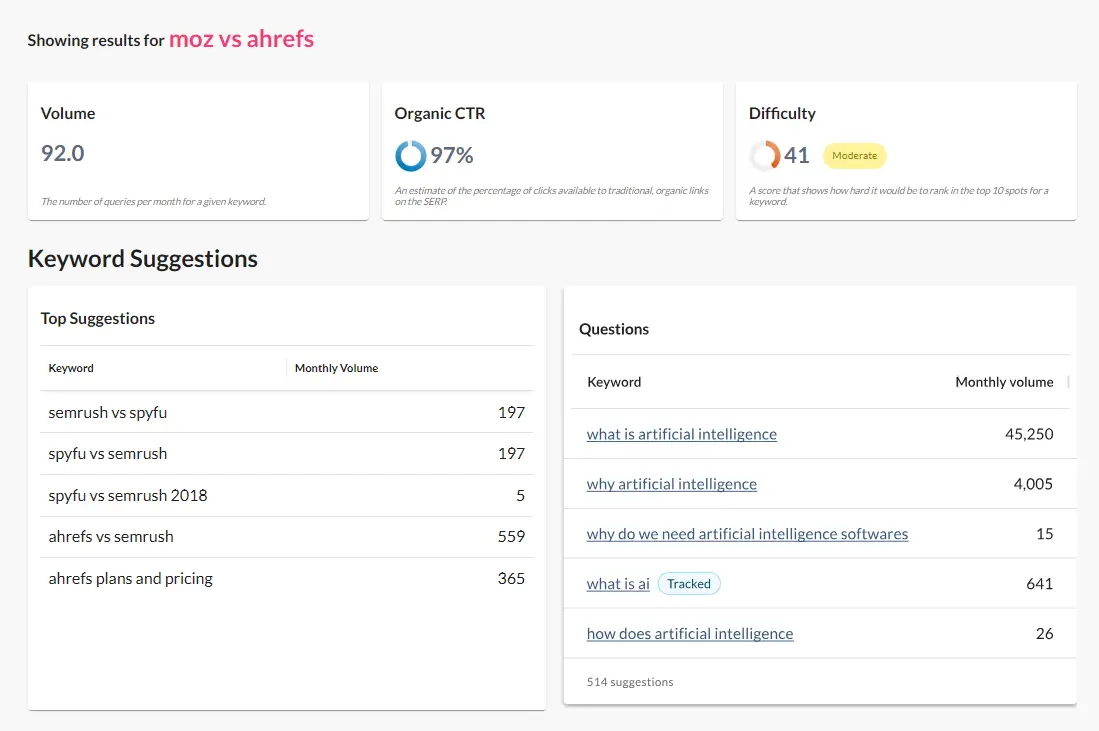
Moz keyword research tool is designed with beginners and intermediate users in mind. It provides related keyword suggestions alongside primary keywords and explains keyword difficulty with a simple score.
Moz focuses on clarity, allowing users to quickly understand which keywords can realistically be ranked for. It’s dataset is comparatively limited, so it sometimes lacks depth in highly competitive niches.
Ahrefs Keyword Generator & Suggestions
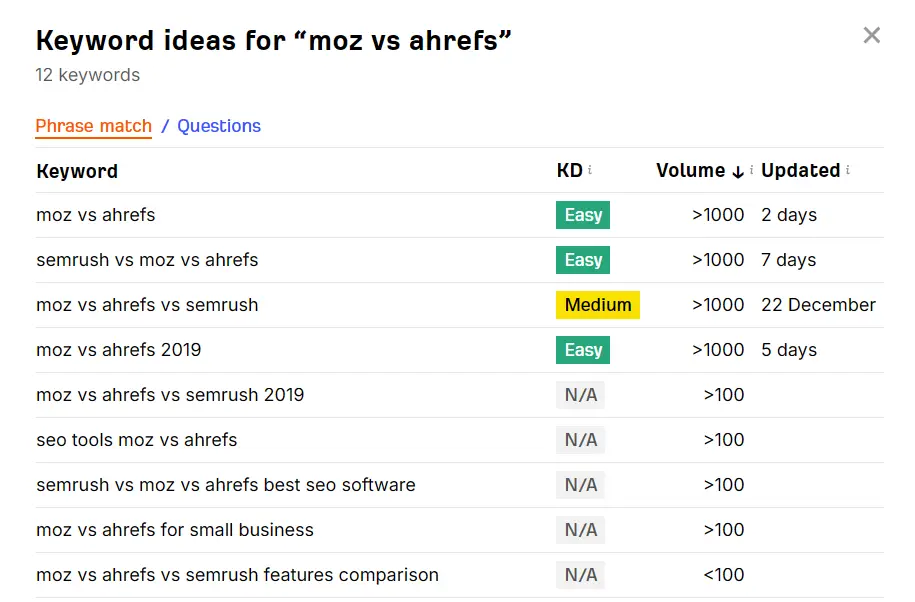
Ahrefs Keyword Explorer takes keyword research to an advanced level. It doesn’t just show search volume, but also provides click data, parent topics, keyword intent, and a SERP overview.
Ahrefs provides keyword ideas for any given keyword, along with its search volume and the most recent update date, which is usually very recent.
Both tools have different approaches when it comes to search volume and keyword difficulty. Moz uses a simplified difficulty score, which is helpful for beginners.
However, Ahrefs calculates difficulty based on backlink data and SERP strength, resulting in better competitive accuracy, It also has an edge in intent analysis for more clearly.
While Ahrefs provides advanced data, SERP strength, you can start with our free keyword generator tool to get some basic keywords ideas for your site.
Winner: Ahrefs (9.5/10)
2. Moz vs Ahrefs: Backlink Analysis
Backlinks remain a key factor in search engine rankings, but today, the quality, relevance, and trust of links matter more than the quantity of website content.
Backlinks remain a core factor in rankings, but today link quality, relevance, and trust matter more than quantity.
This is why the accuracy and database size of SEO tools used for backlink analysis become crucial. A clear difference can be observed between Ahrefs and Moz in this regard.
In competitive niches, I’ve noticed that Ahrefs detects new and lost backlinks much faster, which helps in timely link-building and cleanup decisions.
Moz Backlink Checker
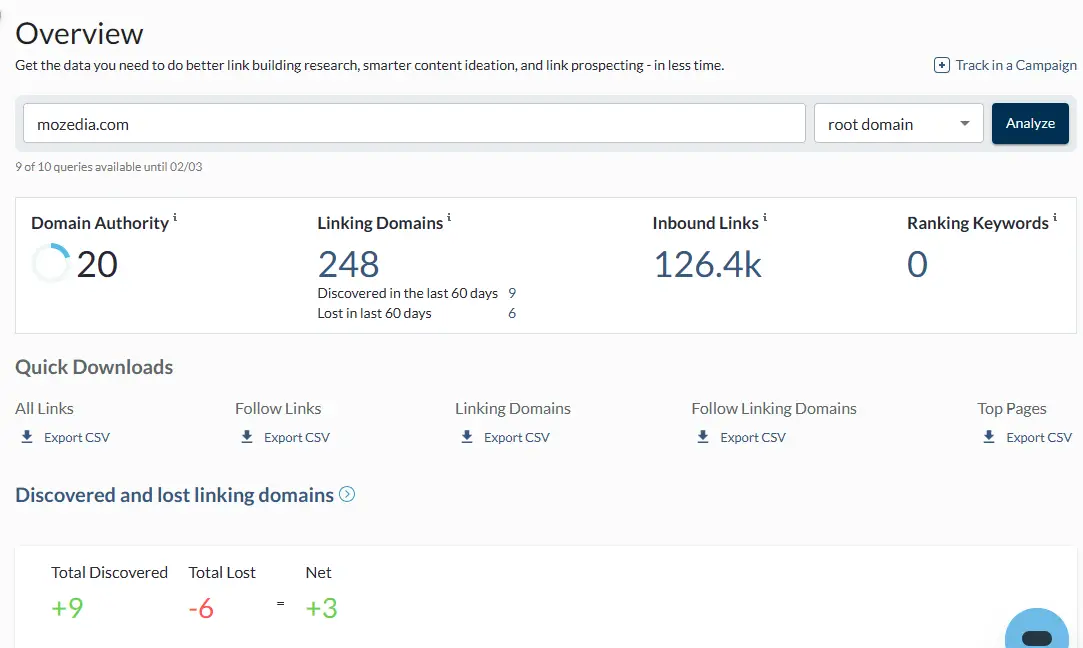
Moz’s backlink tool is reliable, but its index is smaller than Ahrefs. Moz analyzes backlinks in the context of Domain Authority and Spam Score, which provides clarity for beginners.
However, in large-scale competitive niches, Moz sometimes doesn’t detect new or lost backlinks as quickly as Ahrefs, but it is better suited for users who want to basic backlink analysis.
Ahrefs Backlink Audit
Ahrefs backlink audit tool is one of the world’s largest and fastest-updating backlink databases. This tool shows you the complete link profile of any website in details.
This tool is excellent for viewing referring domains, dofollow-nofollow ratios, anchor text distribution, and link growth history. This makes it easier to understand which strong links contribute to a site’s authority.
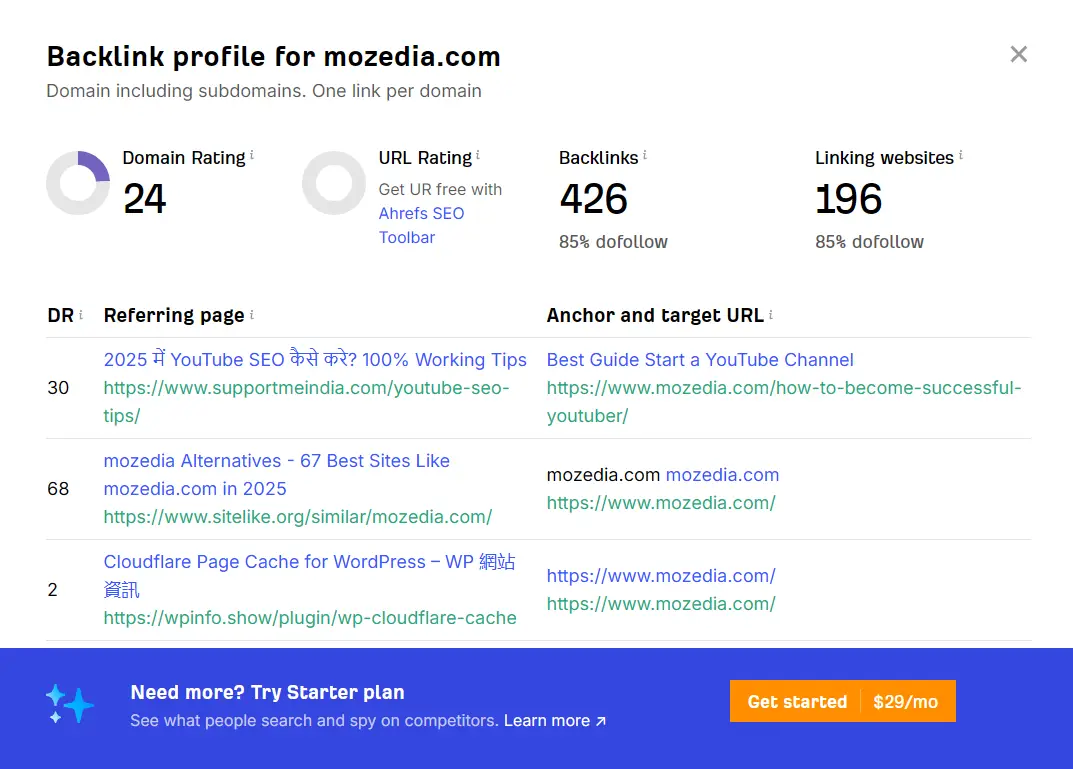
Ahrefs greatest strength is its ability to evaluate link quality at a deep level. This helps in quickly identifying spammy or low-quality links, thereby reducing negative SEO risks.
Additionally, you can analyze your competitors’ websites to see where their most valuable backlinks are coming from and which sources you can target to improve your own link-building strategy.
This is why Ahrefs is widely considered the industry leader for link gap analysis and advanced link building, particularly in large-scale and competitive niches.
If your focus is on aggressive link building, competitor backlink tracking, and long-term authority growth, Ahrefs site explorer proves crucial for your SEO strategy.
If you’re a beginner or have a limited budget, you can initially focus on high-intent, low-competition keywords and topical authority to rank without backlinks.
Winner: Ahrefs (10/10)
3. Moz Domain Authority & Ahrefs Domain Rating
In search engine optimization, both Domain Authority (DA) and Domain Rating (DR) are popular metrics, but they also cause a lot of confusion.
First and foremost, it’s important to understand that DA and DR are not Google ranking factors; rather, they are third-party metrics.
These are third-party metrics and have no direct influence on Google’s search rankings; they simply help you estimate how competitive a website is in search results.
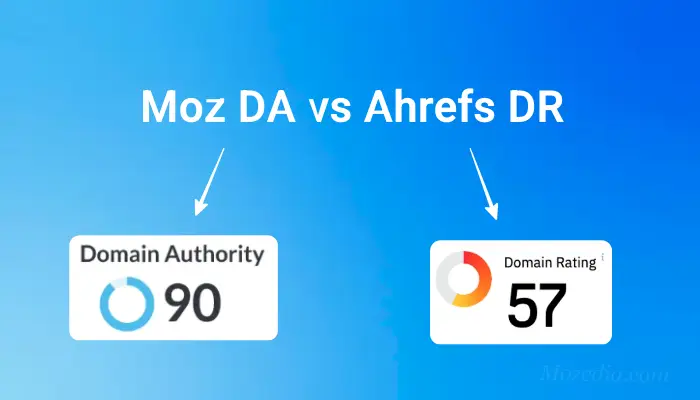
Domain Authority (DA):
Domain Authority was developed by Moz and is a score ranging from 0 to 100. It is primarily calculated by taking into account backlink quality, referring domains, and spam signals.
The advantage of DA is that it makes it easy to understand the strength of a website, which helps beginners and small businesses quickly assess its value.
Domain Rating (DR):
This metric, used by Ahrefs, focuses heavily on the strength and authority of backlinks. Domain Rating indicates how powerful a domain’s backlink profile is.
Ahrefs’ DR metric provides a more accurate signal in competitive environments because it is based on a large backlink dataset of referring domain quality.
Domain Authority (DA) is useful for comparisons and general benchmarking, but Domain Rating (DR) proves more actionable for competitive analysis and link-building strategies.
If you want to improve your site’s metrics, check out our expert’s guide on How to Increase your website domain authority with 7 steps.
Winner: Ahrefs (9/10)
4. Ahrefs vs Moz: Site Audit SEO Comparison
Today’s SEO is not just about content and backlinks; technical optimization, site speed, crawlability, and user experience now play a crucial role in rankings.
This is where site audit tools come in, which assess a website’s technical health and suggest improvements.
Ahrefs and Moz both approach this in different ways.
Moz Pro Site Audit
Moz’s site audit tool focuses on simplicity. It clearly highlights crawl errors, broken links, missing meta tags, duplicate content, and basic on-page issues.
Ahrefs Site Audit
Ahrefs site audit tool is more advanced and in-depth, providing severity levels and suggested fixes for each issue, making it easier to work on large websites and complex SEO projects.
It not only analyzes basic errors but also Core Web Vitals, JavaScript issues, internal linking structure, and performance-related problems in detail.
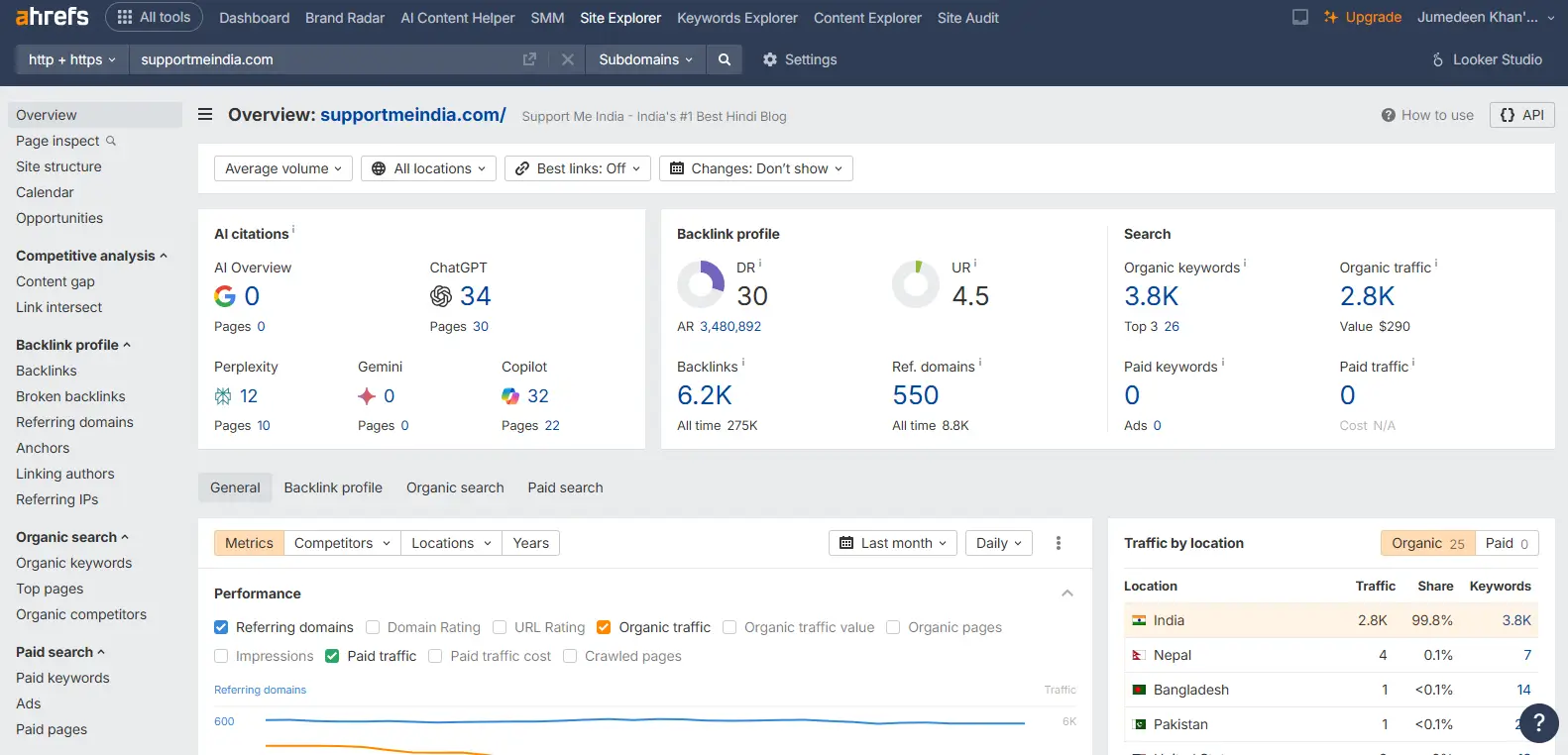
A significant difference is also evident in AI-based SEO recommendations. While Moz provides limited and straightforward recommendations,
Ahrefs offers precise insights into technical patterns based on large datasets. This is why agencies and enterprise-level users prefer Ahrefs’ site audit.
If you want to fix these issues practically, our detailed guide on website speed optimization explains step-by-step methods to improve loading time and technical performance.
Winner: Ahrefs (9.5/10)
5. Competitor Analysis & SERP Insights
Competitor analysis has become one of the most critical activities in search engine optimization. It’s no longer enough to simply know which keywords a competitor is ranking for.
It’s crucial to understand where they are getting their traffic from, which of their content is performing well, and which backlinks are supporting their rankings.
Moz Competitor Analysis
Moz focuses on clarity, making it easy for beginners and small businesses to understand who their main competitors are.
But this analysis remains mostly superficial, lacking in-depth strategic insights.
Ahrefs Competitor Analysis
Ahrefs site explorer and content gap features allow you to clearly see which keywords your competitors are using to drive traffic, which opportunities you’ve missed, and what content is consistently earning them high rankings.
Ahrefs makes it easier to understand and replicate what’s actually working for competitors, which is especially useful in competitive niches, its also stronger in terms of SERP analysis.
It provides a keyword-level SERP overview, where you can analyze ranking pages, backlink strength, search intent, and volatility all in one place.
This makes it easier to decide whether targeting a particular keyword is realistically worthwhile. Moz SERP analysis is limited to basic comparisons and doesn’t display detailed intent signals.
Winner: Ahrefs (10/10)
6. Moz vs Ahrefs: Key Metrics
The biggest challenge in understanding SEO tools lies in their core metrics, as many users make incorrect decisions based on these numbers.
It’s important for you to understand that these metrics are not from Google, but rather third-party indicators that should be used correctly and in context.
Moz Key Metrics
The most popular core metrics from Moz are Domain Authority (DA) and Spam Score. DA shows a website’s overall ranking potential on a scale of 0 to 100, making quick benchmarking easy.
On the other hand, the spam score evaluates the quality of backlinks and indicates whether a website has risky or unnatural links, and if so, how many. This score also ranges from 1 to 100.
These metrics are useful for beginners and small businesses because they are easy to understand and allow for quick decision-making.
Remember, It’s important to note that third-party metrics are not direct ranking factors, as clarified in Google’s official ranking systems documentation.
Ahrefs Key Metrics
Ahrefs metrics are more granular and data-driven. Its Domain Rating (DR) shows domain-level backlink strength, while URL Rating (UR) measures individual page authority.
In addition, Ahrefs Traffic Value metric estimates the monetary value of organic traffic, which is particularly useful because it reflects the real-world impact of SEO efforts.
The biggest difference between the metrics of these two tools lies in their usage philosophy.
Moz metrics are better for comparison and basic evaluation, but Ahrefs metrics prove to be more actionable in SEO strategy and execution.
Winner: Ahrefs (9.5/10)
7. Moz vs Ahrefs: User Interface
It’s crucial for SEO tools to be powerful, but it’s equally important that they are easy to use. Especially in 2026, users expect dashboards that deliver insights with minimal effort.
When SEO tools have become significantly more advanced in terms of data and features, a clear and intuitive user interface directly impacts productivity.
Moz User Interface
Moz’s interface is simple, clean, and easy for new users. The dashboard displays essential metrics and reports in a straightforward manner, making it easy for new users to understand the tool.
Its interface transforms complex data into easy-to-understand visual reports, which is very helpful for bloggers, small business owners, and non-technical users.
Ahrefs User Interface
Ahrefs user interface is more data-heavy and feature-rich. First-time users might find it a bit overwhelming, but for experienced SEO professionals, this becomes a strength.
Ahrefs dashboards offer detailed filters, advanced charts, and in-depth reports, providing greater control and flexibility when working on large websites and competitive projects.
In terms of ease of use, Moz is better for quick decision-making, while Ahrefs is more suitable for detailed analysis and long-term SEO planning.
Winner: Moz (9/10)
8. Moz vs Ahrefs: Pricing & Plans
When choosing an SEO tool, pricing isn’t just about the cost; it’s crucial to consider the actionable value you receive in return for your investment.
Nowadays, these modern SEO tools include AI features and large datasets, making it even more crucial to carefully evaluate the pricing structure.
Moz Pricing and Plans
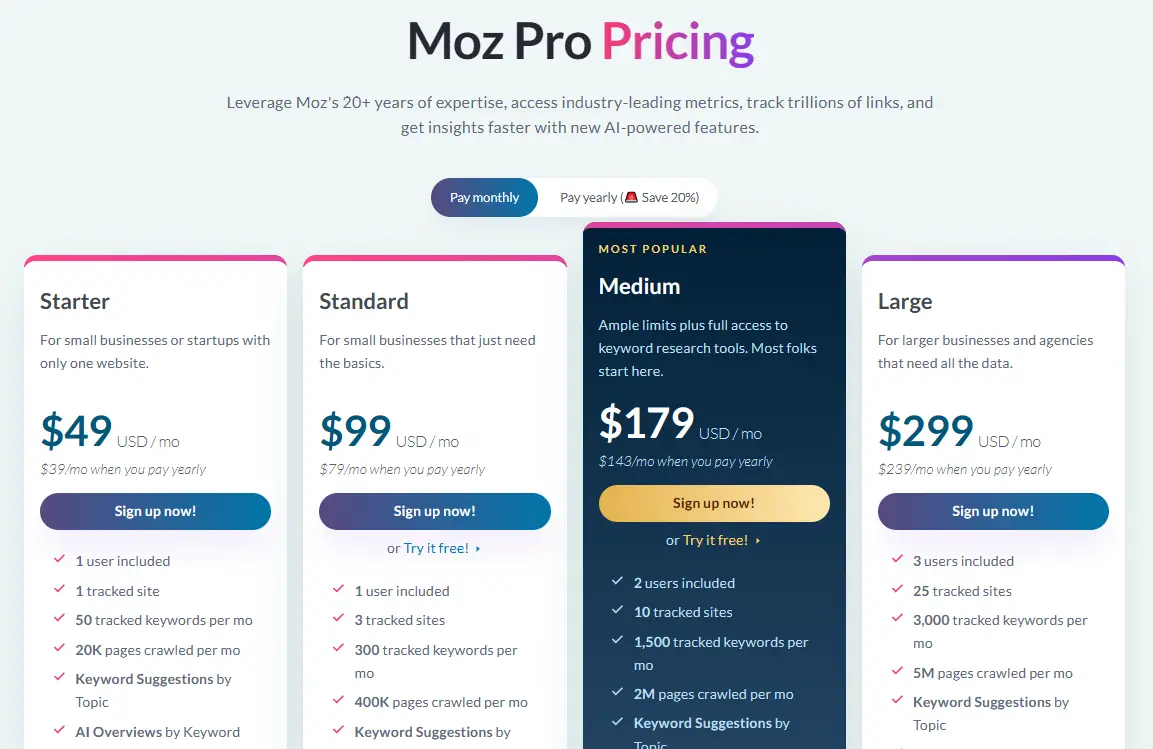
Moz pricing is designed for beginners, bloggers, and small to medium-sized businesses. Its starter plan starts at $49 per month, which is sufficient for the basic SEO needs of single website.
Other plans include Standard ($99/month), Medium ($179/month), and Large ($299/month) plans, which offer more tracked keywords, multiple websites, and advanced keyword research features.
Ahrefs Pricing and Plans
Ahrefs’ pricing falls into the premium category and is clearly targeted at advanced and expert users, large brands, agencies, and professional SEOs.
Ahrefs’ Lite plan starts at $129 per month, which makes it significantly more expensive than Moz’s entry-level plan, and unaffordable for beginners.
Its next plan is priced at $249 per month for the Standard plan and $449 per month for the Advanced plan, which is almost double the price of Moz plans.
In exchange for these expensive plans, Ahrefs offers several excellent features,
Such as large-scale keyword tracking, a generous amount of crawl credits, and access to one of the industry’s largest backlink databases.
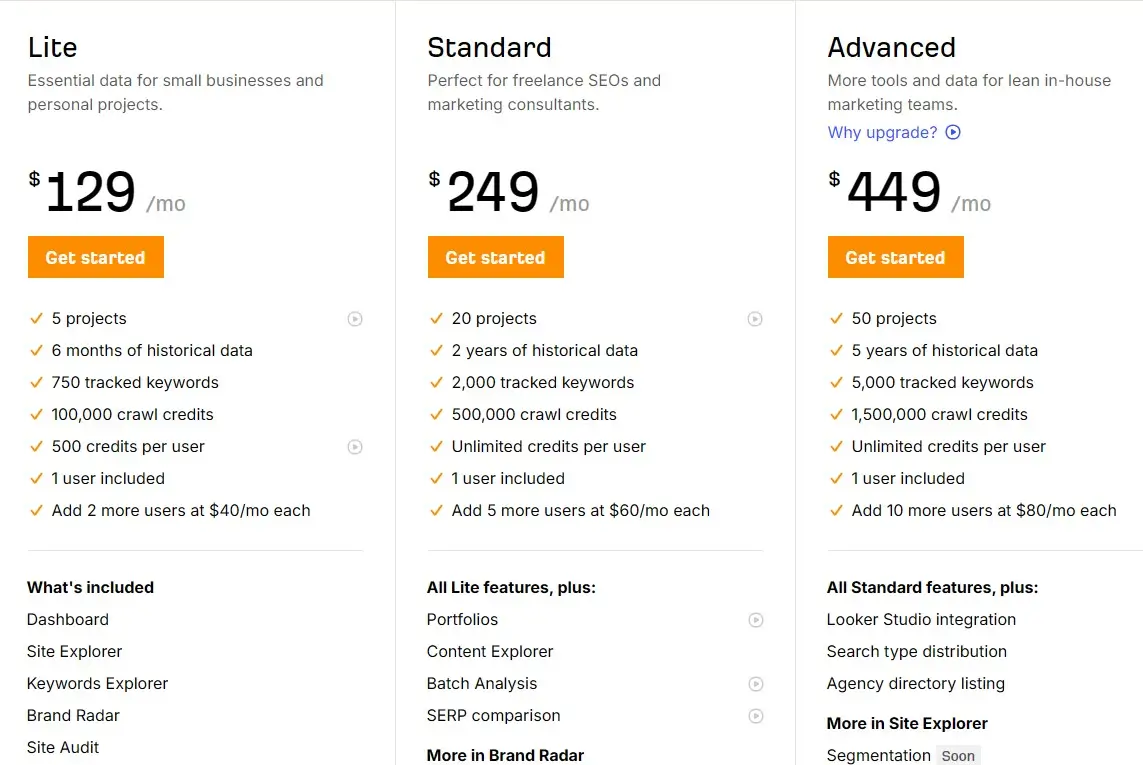
Ahrefs pricing is considered justified because it doesn’t compromise on depth and data accuracy, especially for projects where SEO is directly linked to revenue.
For SEO-driven businesses, the higher cost often makes sense because the data directly impacts traffic and revenue decisions.
However, Ahrefs is a better suited for businesses and professionals, but in terms of value for money, Moz is more suitable for users who want reliable SEO information on a limited budget.
Winner: Moz (9/10)
9. Moz vs Ahrefs: Free Plan & Trials
Many bloggers and beginner SEO users prefer to learn and test using the free version first, so when choosing an SEO tool, it’s crucial to see how much functionality a tool offers for free.
Moz Free Features
- Moz offers several useful free features, keeping beginner users in mind.
- Free Domain Authority Checker – Instantly check the DA of any website.
- Limited Keyword Research – Get an idea of the difficulty and search volume for a few keywords.
- Free Backlink Overview – Information on a limited number of backlinks and referring domains.
- SEO Learning Resources – Guides and tool tips for beginners.
The advantage of Moz’s free features is that they are simple and easy to understand. If you are just starting out with SEO, Moz gives you a basic understanding even without a subscription.
Ahrefs Free Features
The free version of Ahrefs offers fewer tools, but those it does provide are highly data-oriented.
- Free Backlink Checker – Limited but provides real backlink data.
- Free Keyword Generator – Keyword ideas with search volume.
- Free Website Authority Check – Overview of Domain Rating (DR) and basic metrics.
- SERP Preview (Limited) – Keyword-level insights.
If you are a beginner and want to learn SEO, the Moz free trial is sufficient, but if you want quick analysis and to see real data, Ahrefs is a stronger option.
Winner: Ahrefs (9/10)
10. Which SEO tool is best for whom?
Not every SEO tool is right for everyone, and this distinction has become even clearer and choosing a right tool depends on your SEO experience level, project scale, and business goals.
Based on these factors, Moz and Ahrefs prove to be better suited for different types of users; you’ll have to consider your specific needs.
Why should you use Moz?
Moz is best suited for users who are just starting out with SEO or whose focus is on small to medium-sized websites.
This includes new bloggers, local businesses, and in-house teams who want clarity, simple reports, and reliable metrics like Domain Authority.
Why should you use Ahrefs?
Ahrefs is best suited for users who utilize SEO as a growth-driven strategy.
It’s particularly ideal for agencies, affiliate marketers, and advanced SEO professionals who focus on in-depth keyword research, large-scale backlink building, and competitor analysis.
Ahrefs’ data depth and advanced tools provide a clear advantage in large and competitive projects.
In summary, If your goal is simplicity, control, and a manageable SEO workflow, then Moz is the right choice for you.
However, if your goal is aggressive SEO growth and targeting high-competition niches, Ahrefs will be powerful and effective tool in 2026.
Winner: Ahrefs (9/10)
Moz vs Ahrefs: Final Scorecard (Out of 10)
This scorecard reflects practical SEO performance across real projects, not just tool features.
| SEO Factor | Moz | Ahrefs | Winner |
|---|---|---|---|
| Keyword Research | 7/10 | 9.5/10 | Ahrefs |
| Backlink Analysis | 7/10 | 10/10 | Ahrefs |
| Domain Authority / DR | 8/10 | 9/10 | Ahrefs |
| Site Audit | 7.5/10 | 9.5/10 | Ahrefs |
| Competitor Analysis | 7/10 | 10/10 | Ahrefs |
| Key Metrics & Data Depth | 7.5/10 | 9.5/10 | Ahrefs |
| User Interface & Ease of Use | 9/10 | 8/10 | Moz |
| Pricing & Value for Money | 9/10 | 7.5/10 | Moz |
| Other Features | 8/10 | 9/10 | Ahrefs |
| Best For (Use Cases Fit) | 8.5/10 | 9/10 | Ahrefs |
| Overall Rating | 7.9/10 | 9.1/10 | Ahrefs |
As you can see, based on the data, Ahrefs emerges as the overall winner, it’s clear, but the final decision depends on your project’s specific SEO needs.
You can try both the free and paid versions of these SEO tools and decide for yourself; we are simply providing you with a comparison of real-world SEO data.
Note: This score is based on real-world SEO use cases, not just feature lists.
Final Verdict
The answer to “Moz vs. Ahrefs” isn’t a one-size-fits-all solution, as both SEO tools cater to different needs. If your goal is to handle SEO in a simple, and budget-friendly, Moz is a reliable choice.
Moz vs Ahrefs – Which One Should You Choose in 2026?
It works best for beginners, bloggers, and small to mid-sized businesses where clarity, trusted metrics like Domain Authority, spam score, and easy reporting are paramount.
On the other hand, if your focus is on data-driven SEO growth, competitive niches, and long-term authority building, Ahrefs clearly emerges as the more powerful option.
Its deep keyword research, industry-leading backlink database, and advanced competitor analysis are ideal for projects where SEO directly impacts traffic and revenue.
Here’s my final recommendation for choosing an SEO tool:
Ultimately, the right tool for you is the one that matches your SEO goals, experience level, and the scale of your project.
If this guide helps you make the right decision between Moz and Ahrefs tools, share this with your friends.
Let us know, which SEO tool you’ll be using now and why?




I’ve never used Moz, I use Ahrefs and mostly SEMrush. I prefer SEMrush because it provides worldwide data and more detailed insights.
Yes, SEMrush is also a great tool, but this article is focused specifically on Moz vs Ahrefs. Thanks for sharing your experience! 👍